
Sep 19, 2026pneumatic cylinder

Why Cylinder Lubrication Matters in Continuous-Duty Applications

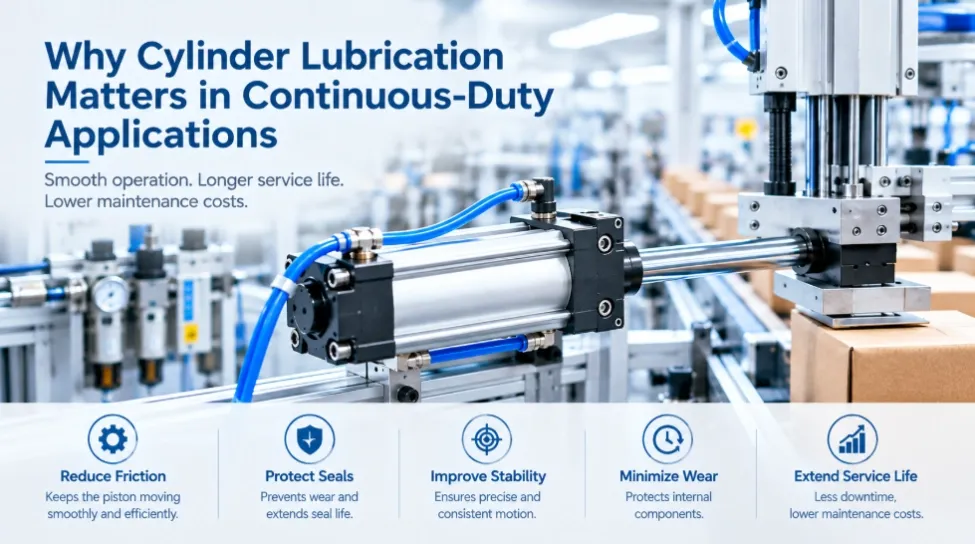
Proper lubrication is essential for pneumatic cylinders operating continuously. It reduces friction, protects seals, minimizes wear, improves motion stability, and extends service life.
989cbc36-19fc-4d59-ba0c-e43be12c803d
Why Cylinder Lubrication Matters in Continuous-Duty Applications
In modern industrial automation, pneumatic cylinders often operate continuously for long hours with minimal downtime. They are found in packaging machines, assembly lines, textile equipment, material handling systems, food processing machinery, and many other automated production environments. While factors such as cylinder design and air quality are important, proper lubrication is one of the key elements that determines whether a cylinder performs reliably over the long term.
When lubrication is neglected, even a well-designed cylinder can experience increased friction, premature wear, and unexpected failures. Understanding the role of lubrication helps maintenance teams improve equipment reliability and reduce operating costs.

Reducing Internal Friction

Inside every pneumatic cylinder, the piston, seals, and guide components move thousands—or even millions—of times during normal operation. Without sufficient lubrication, these moving parts create higher friction, making the cylinder work harder during every cycle.
Excessive friction not only slows cylinder movement but also increases energy consumption and accelerates wear on internal components. Proper lubrication forms a protective film between contacting surfaces, allowing the piston to move smoothly and consistently.

Extending Seal Life

Cylinder seals are responsible for maintaining air pressure and preventing leakage. During continuous operation, seals are constantly exposed to sliding motion, pressure changes, and temperature variations.
A suitable lubricant minimizes direct contact between the seals and the cylinder barrel, reducing wear and preventing the rubber material from drying or cracking. As a result, the seals maintain their sealing performance for a longer period, reducing maintenance frequency and replacement costs.

Improving Motion Stability

Many automated production lines require cylinders to repeat the same movement thousands of times with high precision. Poor lubrication can cause stick-slip motion, where the piston hesitates before moving or fails to travel at a constant speed.
This unstable movement may affect product quality, reduce positioning accuracy, or interrupt automated processes.
Proper lubrication ensures smooth acceleration and consistent movement, helping machines maintain reliable cycle times throughout long production runs.

Protecting Components from Wear

Continuous-duty applications place significant stress on piston rods, guide bushings, and other internal parts. Without adequate lubrication, metal surfaces experience greater wear, leading to scratches, increased clearances, and reduced performance.
Over time, this wear can shorten the service life of the cylinder and increase maintenance costs.
Using high-quality lubricants helps protect these components and keeps the cylinder operating efficiently even under demanding conditions.

Choosing the Right Lubrication Strategy

Not every pneumatic system requires external lubrication. Many modern cylinders are designed with pre-lubricated internal components that provide long-term performance under normal operating conditions.
However, in high-speed, high-frequency, or harsh industrial environments, additional lubrication through a properly maintained FRL (Filter, Regulator, Lubricator) unit may improve reliability.
It's equally important to avoid over-lubrication. Excessive oil can attract dust and contaminants, creating deposits that interfere with valve operation and reduce system efficiency. The best approach is to follow the cylinder manufacturer's maintenance recommendations and use lubricants specifically designed for pneumatic systems.

High-Quality Cylinders Make a Difference

Lubrication works best when combined with a well-manufactured cylinder. Precision machining, durable sealing materials, and high-quality lubricants all contribute to longer service life.
Our DNC pneumatic cylinders are designed for demanding industrial applications. The front and rear end covers are produced in-house using precision die casting to ensure dimensional accuracy and consistent quality. Wear-resistant seals reduce friction during continuous operation, while German-imported lubricants help maintain smooth piston movement and extend service life under high-cycle conditions.

Conclusion

Proper lubrication is one of the simplest and most effective ways to improve pneumatic cylinder performance in continuous-duty applications. It reduces friction, protects seals, minimizes wear, and helps maintain stable, repeatable motion. Combined with clean compressed air, regular maintenance, and high-quality cylinder construction, effective lubrication can significantly reduce downtime and extend the operating life of your automation equipment.
Read next

Sep 19, 2026pneumatic cylinder

Why Cylinder Lubrication Matters in Continuous-Duty Applications

Proper lubrication is essential for pneumatic cylinders operating continuously. It reduces friction, protects seals, minimizes wear, improves motion stability, and extends service life.

989cbc36-19fc-4d59-ba0c-e43be12c803d
Why Cylinder Lubrication Matters in Continuous-Duty Applications
In modern industrial automation, pneumatic cylinders often operate continuously for long hours with minimal downtime. They are found in packaging machines, assembly lines, textile equipment, material handling systems, food processing machinery, and many other automated production environments. While factors such as cylinder design and air quality are important, proper lubrication is one of the key elements that determines whether a cylinder performs reliably over the long term.
When lubrication is neglected, even a well-designed cylinder can experience increased friction, premature wear, and unexpected failures. Understanding the role of lubrication helps maintenance teams improve equipment reliability and reduce operating costs.

Reducing Internal Friction

Inside every pneumatic cylinder, the piston, seals, and guide components move thousands—or even millions—of times during normal operation. Without sufficient lubrication, these moving parts create higher friction, making the cylinder work harder during every cycle.
Excessive friction not only slows cylinder movement but also increases energy consumption and accelerates wear on internal components. Proper lubrication forms a protective film between contacting surfaces, allowing the piston to move smoothly and consistently.

Extending Seal Life

Cylinder seals are responsible for maintaining air pressure and preventing leakage. During continuous operation, seals are constantly exposed to sliding motion, pressure changes, and temperature variations.
A suitable lubricant minimizes direct contact between the seals and the cylinder barrel, reducing wear and preventing the rubber material from drying or cracking. As a result, the seals maintain their sealing performance for a longer period, reducing maintenance frequency and replacement costs.

Improving Motion Stability

Many automated production lines require cylinders to repeat the same movement thousands of times with high precision. Poor lubrication can cause stick-slip motion, where the piston hesitates before moving or fails to travel at a constant speed.
This unstable movement may affect product quality, reduce positioning accuracy, or interrupt automated processes.
Proper lubrication ensures smooth acceleration and consistent movement, helping machines maintain reliable cycle times throughout long production runs.

Protecting Components from Wear

Continuous-duty applications place significant stress on piston rods, guide bushings, and other internal parts. Without adequate lubrication, metal surfaces experience greater wear, leading to scratches, increased clearances, and reduced performance.
Over time, this wear can shorten the service life of the cylinder and increase maintenance costs.
Using high-quality lubricants helps protect these components and keeps the cylinder operating efficiently even under demanding conditions.

Choosing the Right Lubrication Strategy

Not every pneumatic system requires external lubrication. Many modern cylinders are designed with pre-lubricated internal components that provide long-term performance under normal operating conditions.
However, in high-speed, high-frequency, or harsh industrial environments, additional lubrication through a properly maintained FRL (Filter, Regulator, Lubricator) unit may improve reliability.
It's equally important to avoid over-lubrication. Excessive oil can attract dust and contaminants, creating deposits that interfere with valve operation and reduce system efficiency. The best approach is to follow the cylinder manufacturer's maintenance recommendations and use lubricants specifically designed for pneumatic systems.

High-Quality Cylinders Make a Difference

Lubrication works best when combined with a well-manufactured cylinder. Precision machining, durable sealing materials, and high-quality lubricants all contribute to longer service life.
Our DNC pneumatic cylinders are designed for demanding industrial applications. The front and rear end covers are produced in-house using precision die casting to ensure dimensional accuracy and consistent quality. Wear-resistant seals reduce friction during continuous operation, while German-imported lubricants help maintain smooth piston movement and extend service life under high-cycle conditions.

Conclusion

Proper lubrication is one of the simplest and most effective ways to improve pneumatic cylinder performance in continuous-duty applications. It reduces friction, protects seals, minimizes wear, and helps maintain stable, repeatable motion. Combined with clean compressed air, regular maintenance, and high-quality cylinder construction, effective lubrication can significantly reduce downtime and extend the operating life of your automation equipment.


Sep 19, 2026pneumatic cylinder

Why Cylinder Lubrication Matters in Continuous-Duty Applications

Proper lubrication is essential for pneumatic cylinders operating continuously. It reduces friction, protects seals, minimizes wear, improves motion stability, and extends service life.

989cbc36-19fc-4d59-ba0c-e43be12c803d
Why Cylinder Lubrication Matters in Continuous-Duty Applications
In modern industrial automation, pneumatic cylinders often operate continuously for long hours with minimal downtime. They are found in packaging machines, assembly lines, textile equipment, material handling systems, food processing machinery, and many other automated production environments. While factors such as cylinder design and air quality are important, proper lubrication is one of the key elements that determines whether a cylinder performs reliably over the long term.
When lubrication is neglected, even a well-designed cylinder can experience increased friction, premature wear, and unexpected failures. Understanding the role of lubrication helps maintenance teams improve equipment reliability and reduce operating costs.

Reducing Internal Friction

Inside every pneumatic cylinder, the piston, seals, and guide components move thousands—or even millions—of times during normal operation. Without sufficient lubrication, these moving parts create higher friction, making the cylinder work harder during every cycle.
Excessive friction not only slows cylinder movement but also increases energy consumption and accelerates wear on internal components. Proper lubrication forms a protective film between contacting surfaces, allowing the piston to move smoothly and consistently.

Extending Seal Life

Cylinder seals are responsible for maintaining air pressure and preventing leakage. During continuous operation, seals are constantly exposed to sliding motion, pressure changes, and temperature variations.
A suitable lubricant minimizes direct contact between the seals and the cylinder barrel, reducing wear and preventing the rubber material from drying or cracking. As a result, the seals maintain their sealing performance for a longer period, reducing maintenance frequency and replacement costs.

Improving Motion Stability

Many automated production lines require cylinders to repeat the same movement thousands of times with high precision. Poor lubrication can cause stick-slip motion, where the piston hesitates before moving or fails to travel at a constant speed.
This unstable movement may affect product quality, reduce positioning accuracy, or interrupt automated processes.
Proper lubrication ensures smooth acceleration and consistent movement, helping machines maintain reliable cycle times throughout long production runs.

Protecting Components from Wear

Continuous-duty applications place significant stress on piston rods, guide bushings, and other internal parts. Without adequate lubrication, metal surfaces experience greater wear, leading to scratches, increased clearances, and reduced performance.
Over time, this wear can shorten the service life of the cylinder and increase maintenance costs.
Using high-quality lubricants helps protect these components and keeps the cylinder operating efficiently even under demanding conditions.

Choosing the Right Lubrication Strategy

Not every pneumatic system requires external lubrication. Many modern cylinders are designed with pre-lubricated internal components that provide long-term performance under normal operating conditions.
However, in high-speed, high-frequency, or harsh industrial environments, additional lubrication through a properly maintained FRL (Filter, Regulator, Lubricator) unit may improve reliability.
It's equally important to avoid over-lubrication. Excessive oil can attract dust and contaminants, creating deposits that interfere with valve operation and reduce system efficiency. The best approach is to follow the cylinder manufacturer's maintenance recommendations and use lubricants specifically designed for pneumatic systems.

High-Quality Cylinders Make a Difference

Lubrication works best when combined with a well-manufactured cylinder. Precision machining, durable sealing materials, and high-quality lubricants all contribute to longer service life.
Our DNC pneumatic cylinders are designed for demanding industrial applications. The front and rear end covers are produced in-house using precision die casting to ensure dimensional accuracy and consistent quality. Wear-resistant seals reduce friction during continuous operation, while German-imported lubricants help maintain smooth piston movement and extend service life under high-cycle conditions.

Conclusion

Proper lubrication is one of the simplest and most effective ways to improve pneumatic cylinder performance in continuous-duty applications. It reduces friction, protects seals, minimizes wear, and helps maintain stable, repeatable motion. Combined with clean compressed air, regular maintenance, and high-quality cylinder construction, effective lubrication can significantly reduce downtime and extend the operating life of your automation equipment.


Recommended articles

Guides visitors may want next

Helpful guides, field notes, and stories for choosing with more context.