
Sep 27, 2026pneumatic cylinder

Pneumatic Cylinder Types Explained: Choosing the Right Cylinder for Your Application

Standard cylinders offer versatility, compact cylinders save space, rodless cylinders provide long travel in a small footprint, and guided cylinders improve precision and stability.
398a2e5e-b1b1-45d2-9e66-0e1775ebaced
Pneumatic Cylinder Types Explained: Choosing the Right Cylinder for Your Application
Pneumatic cylinders are among the most widely used actuators in industrial automation. They convert compressed air into linear motion and are found in packaging machines, assembly lines, material handling systems, textile equipment, woodworking machinery, and many other automated applications. While the operating principle is straightforward, selecting the right cylinder type is not always easy. Different designs are built for different working conditions, and using the wrong one can reduce efficiency or shorten service life.
This guide explains the most common pneumatic cylinder types and where each performs best.

1. Standard Cylinders

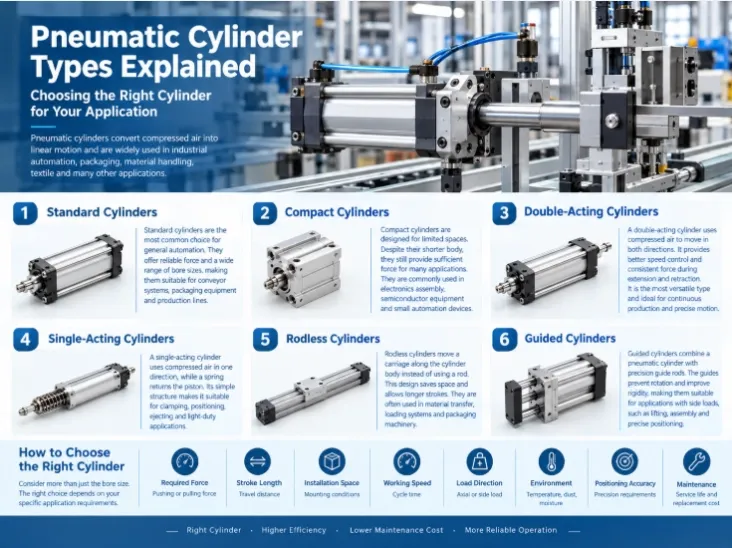
Standard cylinders are the most common choice for general industrial automation. They feature a round or profile barrel with a relatively long stroke and provide reliable pushing or pulling force.
They are suitable for applications such as conveyor systems, packaging equipment, and automated production lines. Because of their simple construction and wide range of bore sizes, they are often the first choice for new machine designs.

2. Compact Cylinders

Compact cylinders are designed for installations where mounting space is limited. Although their body length is shorter than a standard cylinder, they can still provide sufficient output force for many applications.
Compact cylinders are commonly used in electronics assembly, semiconductor equipment, pick-and-place systems, and small automation devices where every millimeter of space matters.

3. Double-Acting Cylinders

A double-acting cylinder uses compressed air to move the piston in both directions. This provides better speed control and consistent force during extension and retraction.
Because of their versatility, double-acting cylinders account for the majority of pneumatic cylinder installations in industrial automation. They are ideal for continuous production where precise and repeatable motion is required.

4. Single-Acting Cylinders

Single-acting cylinders use compressed air for movement in one direction, while an internal spring returns the piston to its original position.
Their simple structure makes them suitable for light-duty applications such as clamping, positioning, ejecting, and small pressing operations. However, the available force is limited by the spring design, making them less suitable for heavy-duty tasks.

5. Rodless Cylinders

Unlike traditional cylinders, rodless cylinders move a carriage along the cylinder body rather than extending a piston rod. This design saves installation space while allowing longer strokes.
Rodless cylinders are often used in material transfer, automated loading systems, and packaging machinery where long travel distances are required but machine space is limited.

6. Guided Cylinders

Guided cylinders combine a pneumatic cylinder with precision guide rods. The guides improve rigidity and prevent rotation, making the cylinder suitable for applications involving side loads.
Typical uses include lifting components, precision assembly, and positioning delicate workpieces where accurate alignment is essential.

How to Choose the Right Cylinder

When selecting a pneumatic cylinder, consider more than just the bore size. Important factors include:
  • Required pushing or pulling force
  • Stroke length
  • Available installation space
  • Working speed
  • Load direction
  • Operating environment
  • Required positioning accuracy
  • Maintenance requirements
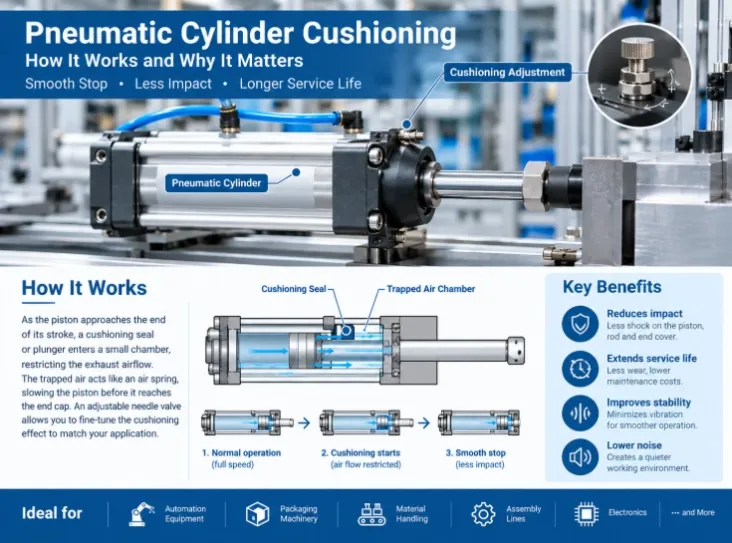
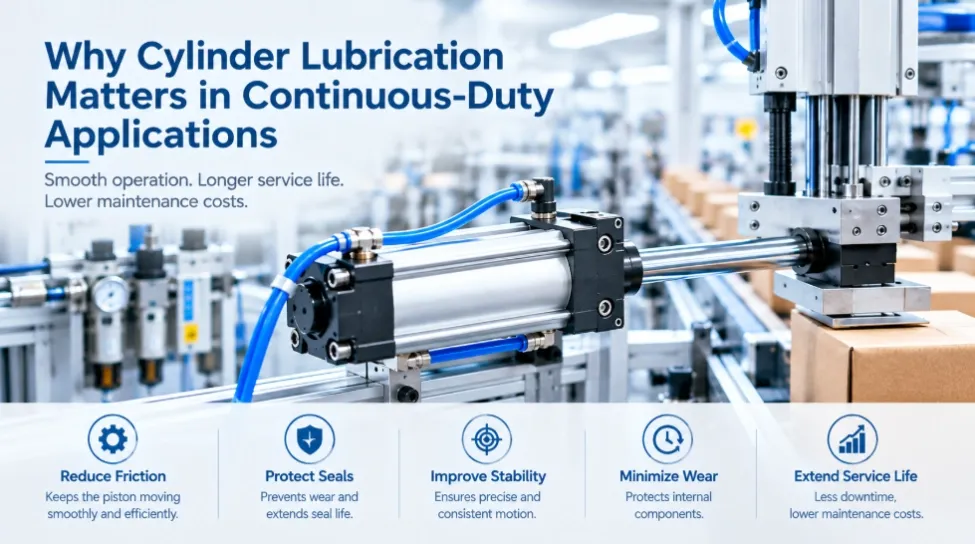
For demanding environments, choosing cylinders with wear-resistant seals, high-quality lubrication, and durable end covers can significantly extend service life and reduce maintenance costs.

Final Thoughts

Every pneumatic cylinder is designed for a specific purpose. Standard cylinders offer versatility, compact cylinders save space, rodless cylinders provide long travel in a small footprint, and guided cylinders improve precision and stability.
Understanding these differences helps engineers and purchasing teams select the most suitable solution for each application. A properly selected cylinder not only improves machine performance but also minimizes downtime, lowers maintenance costs, and increases the overall reliability of an automated production system.
Read next

Sep 27, 2026pneumatic cylinder

Pneumatic Cylinder Types Explained: Choosing the Right Cylinder for Your Application

Standard cylinders offer versatility, compact cylinders save space, rodless cylinders provide long travel in a small footprint, and guided cylinders improve precision and stability.

398a2e5e-b1b1-45d2-9e66-0e1775ebaced
Pneumatic Cylinder Types Explained: Choosing the Right Cylinder for Your Application
Pneumatic cylinders are among the most widely used actuators in industrial automation. They convert compressed air into linear motion and are found in packaging machines, assembly lines, material handling systems, textile equipment, woodworking machinery, and many other automated applications. While the operating principle is straightforward, selecting the right cylinder type is not always easy. Different designs are built for different working conditions, and using the wrong one can reduce efficiency or shorten service life.
This guide explains the most common pneumatic cylinder types and where each performs best.

1. Standard Cylinders

Standard cylinders are the most common choice for general industrial automation. They feature a round or profile barrel with a relatively long stroke and provide reliable pushing or pulling force.
They are suitable for applications such as conveyor systems, packaging equipment, and automated production lines. Because of their simple construction and wide range of bore sizes, they are often the first choice for new machine designs.

2. Compact Cylinders

Compact cylinders are designed for installations where mounting space is limited. Although their body length is shorter than a standard cylinder, they can still provide sufficient output force for many applications.
Compact cylinders are commonly used in electronics assembly, semiconductor equipment, pick-and-place systems, and small automation devices where every millimeter of space matters.

3. Double-Acting Cylinders

A double-acting cylinder uses compressed air to move the piston in both directions. This provides better speed control and consistent force during extension and retraction.
Because of their versatility, double-acting cylinders account for the majority of pneumatic cylinder installations in industrial automation. They are ideal for continuous production where precise and repeatable motion is required.

4. Single-Acting Cylinders

Single-acting cylinders use compressed air for movement in one direction, while an internal spring returns the piston to its original position.
Their simple structure makes them suitable for light-duty applications such as clamping, positioning, ejecting, and small pressing operations. However, the available force is limited by the spring design, making them less suitable for heavy-duty tasks.

5. Rodless Cylinders

Unlike traditional cylinders, rodless cylinders move a carriage along the cylinder body rather than extending a piston rod. This design saves installation space while allowing longer strokes.
Rodless cylinders are often used in material transfer, automated loading systems, and packaging machinery where long travel distances are required but machine space is limited.

6. Guided Cylinders

Guided cylinders combine a pneumatic cylinder with precision guide rods. The guides improve rigidity and prevent rotation, making the cylinder suitable for applications involving side loads.
Typical uses include lifting components, precision assembly, and positioning delicate workpieces where accurate alignment is essential.

How to Choose the Right Cylinder

When selecting a pneumatic cylinder, consider more than just the bore size. Important factors include:
  • Required pushing or pulling force
  • Stroke length
  • Available installation space
  • Working speed
  • Load direction
  • Operating environment
  • Required positioning accuracy
  • Maintenance requirements
For demanding environments, choosing cylinders with wear-resistant seals, high-quality lubrication, and durable end covers can significantly extend service life and reduce maintenance costs.

Final Thoughts

Every pneumatic cylinder is designed for a specific purpose. Standard cylinders offer versatility, compact cylinders save space, rodless cylinders provide long travel in a small footprint, and guided cylinders improve precision and stability.
Understanding these differences helps engineers and purchasing teams select the most suitable solution for each application. A properly selected cylinder not only improves machine performance but also minimizes downtime, lowers maintenance costs, and increases the overall reliability of an automated production system.


Sep 27, 2026pneumatic cylinder

Pneumatic Cylinder Types Explained: Choosing the Right Cylinder for Your Application

Standard cylinders offer versatility, compact cylinders save space, rodless cylinders provide long travel in a small footprint, and guided cylinders improve precision and stability.

398a2e5e-b1b1-45d2-9e66-0e1775ebaced
Pneumatic Cylinder Types Explained: Choosing the Right Cylinder for Your Application
Pneumatic cylinders are among the most widely used actuators in industrial automation. They convert compressed air into linear motion and are found in packaging machines, assembly lines, material handling systems, textile equipment, woodworking machinery, and many other automated applications. While the operating principle is straightforward, selecting the right cylinder type is not always easy. Different designs are built for different working conditions, and using the wrong one can reduce efficiency or shorten service life.
This guide explains the most common pneumatic cylinder types and where each performs best.

1. Standard Cylinders

Standard cylinders are the most common choice for general industrial automation. They feature a round or profile barrel with a relatively long stroke and provide reliable pushing or pulling force.
They are suitable for applications such as conveyor systems, packaging equipment, and automated production lines. Because of their simple construction and wide range of bore sizes, they are often the first choice for new machine designs.

2. Compact Cylinders

Compact cylinders are designed for installations where mounting space is limited. Although their body length is shorter than a standard cylinder, they can still provide sufficient output force for many applications.
Compact cylinders are commonly used in electronics assembly, semiconductor equipment, pick-and-place systems, and small automation devices where every millimeter of space matters.

3. Double-Acting Cylinders

A double-acting cylinder uses compressed air to move the piston in both directions. This provides better speed control and consistent force during extension and retraction.
Because of their versatility, double-acting cylinders account for the majority of pneumatic cylinder installations in industrial automation. They are ideal for continuous production where precise and repeatable motion is required.

4. Single-Acting Cylinders

Single-acting cylinders use compressed air for movement in one direction, while an internal spring returns the piston to its original position.
Their simple structure makes them suitable for light-duty applications such as clamping, positioning, ejecting, and small pressing operations. However, the available force is limited by the spring design, making them less suitable for heavy-duty tasks.

5. Rodless Cylinders

Unlike traditional cylinders, rodless cylinders move a carriage along the cylinder body rather than extending a piston rod. This design saves installation space while allowing longer strokes.
Rodless cylinders are often used in material transfer, automated loading systems, and packaging machinery where long travel distances are required but machine space is limited.

6. Guided Cylinders

Guided cylinders combine a pneumatic cylinder with precision guide rods. The guides improve rigidity and prevent rotation, making the cylinder suitable for applications involving side loads.
Typical uses include lifting components, precision assembly, and positioning delicate workpieces where accurate alignment is essential.

How to Choose the Right Cylinder

When selecting a pneumatic cylinder, consider more than just the bore size. Important factors include:
  • Required pushing or pulling force
  • Stroke length
  • Available installation space
  • Working speed
  • Load direction
  • Operating environment
  • Required positioning accuracy
  • Maintenance requirements
For demanding environments, choosing cylinders with wear-resistant seals, high-quality lubrication, and durable end covers can significantly extend service life and reduce maintenance costs.

Final Thoughts

Every pneumatic cylinder is designed for a specific purpose. Standard cylinders offer versatility, compact cylinders save space, rodless cylinders provide long travel in a small footprint, and guided cylinders improve precision and stability.
Understanding these differences helps engineers and purchasing teams select the most suitable solution for each application. A properly selected cylinder not only improves machine performance but also minimizes downtime, lowers maintenance costs, and increases the overall reliability of an automated production system.


Recommended articles

Guides visitors may want next

Helpful guides, field notes, and stories for choosing with more context.