
Sep 25, 2026pneumatic cylinder

Pneumatic Cylinder Cushioning: How It Works and Why It Matters

Cylinder cushioning is often overlooked, but it plays a major role in the reliability and longevity of pneumatic systems.
1bc3eedc-27b6-45f1-9aba-60f2de449edd
Pneumatic Cylinder Cushioning: How It Works and Why It Matters
In many automation systems, pneumatic cylinders operate thousands of times every day. At low speeds, stopping the piston is usually not a problem. However, when a cylinder moves quickly or carries a heavy load, the piston can hit the end cover with considerable force. This repeated impact creates vibration, noise, and unnecessary wear. Over time, it can shorten the service life of both the cylinder and the machine. That is why cushioning is an important feature in modern pneumatic cylinders.

What Is Pneumatic Cylinder Cushioning?

Cylinder cushioning is a built-in mechanism that slows the piston down just before it reaches the end of its stroke. Instead of stopping suddenly, the piston decelerates smoothly, reducing impact energy and protecting internal components.
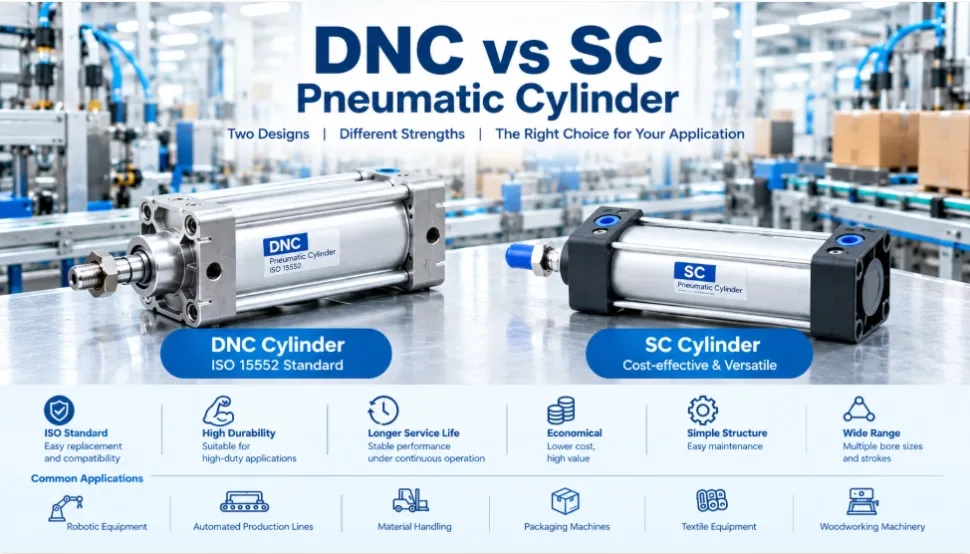
Most standard cylinders, such as SC and DNC series cylinders, are equipped with adjustable air cushioning at both ends. For applications with light loads or low speeds, fixed cushioning or rubber bumpers may also be sufficient.

How Does Cushioning Work?

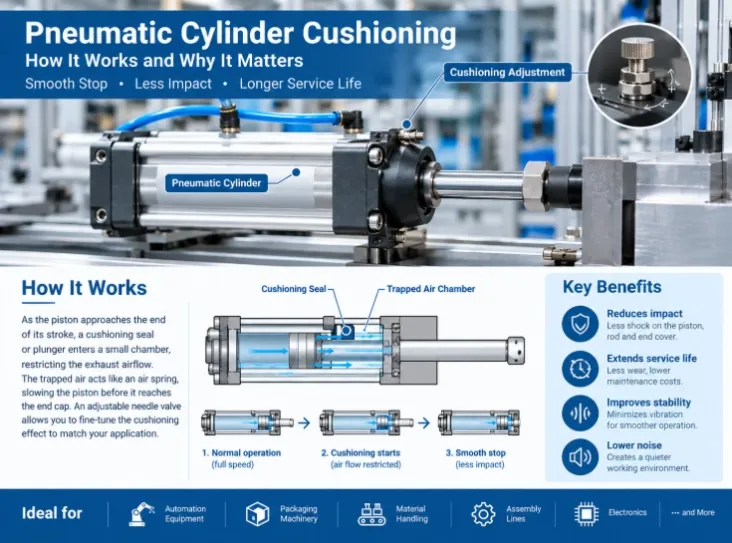
The principle is straightforward. As the piston approaches the end cap, a cushioning seal or plunger enters a small chamber inside the cylinder. This restricts the normal exhaust airflow, causing compressed air to remain trapped in the chamber.
The trapped air acts like an air spring, slowing the piston before it reaches the end of its travel. A small adjustable needle valve allows operators to control how quickly the air escapes, making it possible to fine-tune the cushioning effect according to the application.
If the adjustment is too tight, the piston may slow down too much or even fail to complete its stroke. If it is too loose, the piston will still strike the end cover with excessive force. Proper adjustment is therefore essential for stable operation.

Why Cushioning Is Important

A well-adjusted cushioning system offers several practical benefits.
First, it reduces mechanical shock. Less impact means less stress on piston rods, seals, bearings, and machine frames.
Second, it extends cylinder life. Internal components experience lower wear, reducing maintenance frequency and replacement costs.
Third, cushioning improves machine stability. Smooth stopping minimizes vibration, which is especially valuable in precision assembly, packaging, electronics, and material handling equipment.
Finally, it lowers operating noise. In factories where cylinders cycle continuously, quieter operation creates a better working environment.

When Should You Use Adjustable Cushioning?

Adjustable cushioning is recommended whenever cylinders operate under demanding conditions, including:
  • High-speed reciprocating motion
  • Long stroke cylinders
  • Heavy loads
  • Frequent cycling
  • Automated production lines
  • Pick-and-place systems
  • Packaging and conveyor equipment
In these applications, proper cushioning not only protects the cylinder itself but also helps safeguard connected tooling and machine structures.

Tips for Better Cushioning Performance

To achieve the best results, always select a cylinder with the correct bore size and stroke for the required load. Oversized cylinders may create unnecessary impact force, while undersized cylinders may struggle to move the load efficiently.
During installation, adjust the cushioning gradually rather than closing the needle valve completely. Observe the cylinder during operation and fine-tune the setting until the piston stops smoothly without bouncing or producing excessive noise.
Regular maintenance is equally important. Check for air leaks, worn seals, contaminated compressed air, or damaged cushioning components, as these issues can reduce cushioning performance.

Conclusion

Cylinder cushioning is often overlooked, but it plays a major role in the reliability and longevity of pneumatic systems. By slowing the piston before it reaches the end of its stroke, cushioning reduces impact, minimizes wear, lowers noise, and improves overall machine performance. Whether you are designing new automation equipment or maintaining an existing production line, correctly selecting and adjusting cylinder cushioning is a simple step that can significantly improve efficiency and reduce long-term maintenance costs.


Read next

Sep 25, 2026pneumatic cylinder

Pneumatic Cylinder Cushioning: How It Works and Why It Matters

Cylinder cushioning is often overlooked, but it plays a major role in the reliability and longevity of pneumatic systems.

1bc3eedc-27b6-45f1-9aba-60f2de449edd
Pneumatic Cylinder Cushioning: How It Works and Why It Matters
In many automation systems, pneumatic cylinders operate thousands of times every day. At low speeds, stopping the piston is usually not a problem. However, when a cylinder moves quickly or carries a heavy load, the piston can hit the end cover with considerable force. This repeated impact creates vibration, noise, and unnecessary wear. Over time, it can shorten the service life of both the cylinder and the machine. That is why cushioning is an important feature in modern pneumatic cylinders.

What Is Pneumatic Cylinder Cushioning?

Cylinder cushioning is a built-in mechanism that slows the piston down just before it reaches the end of its stroke. Instead of stopping suddenly, the piston decelerates smoothly, reducing impact energy and protecting internal components.
Most standard cylinders, such as SC and DNC series cylinders, are equipped with adjustable air cushioning at both ends. For applications with light loads or low speeds, fixed cushioning or rubber bumpers may also be sufficient.

How Does Cushioning Work?

The principle is straightforward. As the piston approaches the end cap, a cushioning seal or plunger enters a small chamber inside the cylinder. This restricts the normal exhaust airflow, causing compressed air to remain trapped in the chamber.
The trapped air acts like an air spring, slowing the piston before it reaches the end of its travel. A small adjustable needle valve allows operators to control how quickly the air escapes, making it possible to fine-tune the cushioning effect according to the application.
If the adjustment is too tight, the piston may slow down too much or even fail to complete its stroke. If it is too loose, the piston will still strike the end cover with excessive force. Proper adjustment is therefore essential for stable operation.

Why Cushioning Is Important

A well-adjusted cushioning system offers several practical benefits.
First, it reduces mechanical shock. Less impact means less stress on piston rods, seals, bearings, and machine frames.
Second, it extends cylinder life. Internal components experience lower wear, reducing maintenance frequency and replacement costs.
Third, cushioning improves machine stability. Smooth stopping minimizes vibration, which is especially valuable in precision assembly, packaging, electronics, and material handling equipment.
Finally, it lowers operating noise. In factories where cylinders cycle continuously, quieter operation creates a better working environment.

When Should You Use Adjustable Cushioning?

Adjustable cushioning is recommended whenever cylinders operate under demanding conditions, including:
  • High-speed reciprocating motion
  • Long stroke cylinders
  • Heavy loads
  • Frequent cycling
  • Automated production lines
  • Pick-and-place systems
  • Packaging and conveyor equipment
In these applications, proper cushioning not only protects the cylinder itself but also helps safeguard connected tooling and machine structures.

Tips for Better Cushioning Performance

To achieve the best results, always select a cylinder with the correct bore size and stroke for the required load. Oversized cylinders may create unnecessary impact force, while undersized cylinders may struggle to move the load efficiently.
During installation, adjust the cushioning gradually rather than closing the needle valve completely. Observe the cylinder during operation and fine-tune the setting until the piston stops smoothly without bouncing or producing excessive noise.
Regular maintenance is equally important. Check for air leaks, worn seals, contaminated compressed air, or damaged cushioning components, as these issues can reduce cushioning performance.

Conclusion

Cylinder cushioning is often overlooked, but it plays a major role in the reliability and longevity of pneumatic systems. By slowing the piston before it reaches the end of its stroke, cushioning reduces impact, minimizes wear, lowers noise, and improves overall machine performance. Whether you are designing new automation equipment or maintaining an existing production line, correctly selecting and adjusting cylinder cushioning is a simple step that can significantly improve efficiency and reduce long-term maintenance costs.


Sep 25, 2026pneumatic cylinder

Pneumatic Cylinder Cushioning: How It Works and Why It Matters

Cylinder cushioning is often overlooked, but it plays a major role in the reliability and longevity of pneumatic systems.

1bc3eedc-27b6-45f1-9aba-60f2de449edd
Pneumatic Cylinder Cushioning: How It Works and Why It Matters
In many automation systems, pneumatic cylinders operate thousands of times every day. At low speeds, stopping the piston is usually not a problem. However, when a cylinder moves quickly or carries a heavy load, the piston can hit the end cover with considerable force. This repeated impact creates vibration, noise, and unnecessary wear. Over time, it can shorten the service life of both the cylinder and the machine. That is why cushioning is an important feature in modern pneumatic cylinders.

What Is Pneumatic Cylinder Cushioning?

Cylinder cushioning is a built-in mechanism that slows the piston down just before it reaches the end of its stroke. Instead of stopping suddenly, the piston decelerates smoothly, reducing impact energy and protecting internal components.
Most standard cylinders, such as SC and DNC series cylinders, are equipped with adjustable air cushioning at both ends. For applications with light loads or low speeds, fixed cushioning or rubber bumpers may also be sufficient.

How Does Cushioning Work?

The principle is straightforward. As the piston approaches the end cap, a cushioning seal or plunger enters a small chamber inside the cylinder. This restricts the normal exhaust airflow, causing compressed air to remain trapped in the chamber.
The trapped air acts like an air spring, slowing the piston before it reaches the end of its travel. A small adjustable needle valve allows operators to control how quickly the air escapes, making it possible to fine-tune the cushioning effect according to the application.
If the adjustment is too tight, the piston may slow down too much or even fail to complete its stroke. If it is too loose, the piston will still strike the end cover with excessive force. Proper adjustment is therefore essential for stable operation.

Why Cushioning Is Important

A well-adjusted cushioning system offers several practical benefits.
First, it reduces mechanical shock. Less impact means less stress on piston rods, seals, bearings, and machine frames.
Second, it extends cylinder life. Internal components experience lower wear, reducing maintenance frequency and replacement costs.
Third, cushioning improves machine stability. Smooth stopping minimizes vibration, which is especially valuable in precision assembly, packaging, electronics, and material handling equipment.
Finally, it lowers operating noise. In factories where cylinders cycle continuously, quieter operation creates a better working environment.

When Should You Use Adjustable Cushioning?

Adjustable cushioning is recommended whenever cylinders operate under demanding conditions, including:
  • High-speed reciprocating motion
  • Long stroke cylinders
  • Heavy loads
  • Frequent cycling
  • Automated production lines
  • Pick-and-place systems
  • Packaging and conveyor equipment
In these applications, proper cushioning not only protects the cylinder itself but also helps safeguard connected tooling and machine structures.

Tips for Better Cushioning Performance

To achieve the best results, always select a cylinder with the correct bore size and stroke for the required load. Oversized cylinders may create unnecessary impact force, while undersized cylinders may struggle to move the load efficiently.
During installation, adjust the cushioning gradually rather than closing the needle valve completely. Observe the cylinder during operation and fine-tune the setting until the piston stops smoothly without bouncing or producing excessive noise.
Regular maintenance is equally important. Check for air leaks, worn seals, contaminated compressed air, or damaged cushioning components, as these issues can reduce cushioning performance.

Conclusion

Cylinder cushioning is often overlooked, but it plays a major role in the reliability and longevity of pneumatic systems. By slowing the piston before it reaches the end of its stroke, cushioning reduces impact, minimizes wear, lowers noise, and improves overall machine performance. Whether you are designing new automation equipment or maintaining an existing production line, correctly selecting and adjusting cylinder cushioning is a simple step that can significantly improve efficiency and reduce long-term maintenance costs.


Recommended articles

Guides visitors may want next

Helpful guides, field notes, and stories for choosing with more context.