Sep 30, 2026pneumatic cylinder
Pneumatic Cylinder Accessories Guide: Essential Components for Better Performance
Pneumatic cylinder accessories are more than optional add-ons—they are essential components that ensure smooth operation, accurate positioning, and long service life.
Pneumatic Cylinder Accessories Guide: Essential Components for Better Performance
A pneumatic cylinder is only one part of a complete pneumatic system. To achieve reliable performance, longer service life, and easier installation, it should be paired with the right accessories. While accessories may seem like small components, they play a significant role in protecting the cylinder, improving motion control, and reducing maintenance.
Whether you're building a new machine or replacing existing parts, understanding the function of common pneumatic cylinder accessories can help you make better purchasing decisions.
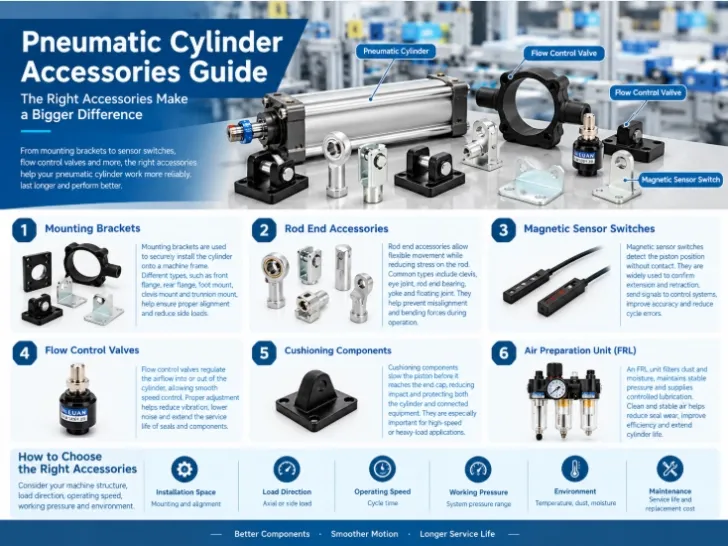
1. Mounting Brackets
Mounting brackets are used to securely install the cylinder onto a machine frame. Different applications require different mounting methods, including front flange, rear flange, foot mount, clevis mount, and trunnion mount.
Selecting the correct bracket ensures proper alignment between the cylinder and the load. Poor installation can create side loads, increase seal wear, and shorten cylinder life.
2. Rod End Accessories
The piston rod connects the cylinder to the moving equipment. Rod end accessories allow flexible movement while reducing stress on the rod.
Common rod end fittings include:
- Clevis
- Eye joint
- Rod end bearing
- Yoke
- Floating joint
These accessories compensate for slight misalignment and help prevent bending forces during operation.
3. Magnetic Sensor Switches
Many modern pneumatic cylinders include an internal magnet on the piston. Magnetic sensors detect the piston's position without physical contact.
These switches are widely used in automated production lines to:
- Confirm cylinder extension and retraction
- Send signals to PLC control systems
- Improve production accuracy
- Reduce cycle errors
Because there is no mechanical contact, sensor switches offer long service life and reliable performance.
4. Flow Control Valves
Cylinder speed is usually adjusted with flow control valves rather than changing the air pressure.
By controlling the airflow entering or leaving the cylinder, operators can achieve smooth acceleration and deceleration while preventing sudden impacts.
Proper speed control also helps reduce vibration, lower noise, and extend the service life of seals and mechanical parts.
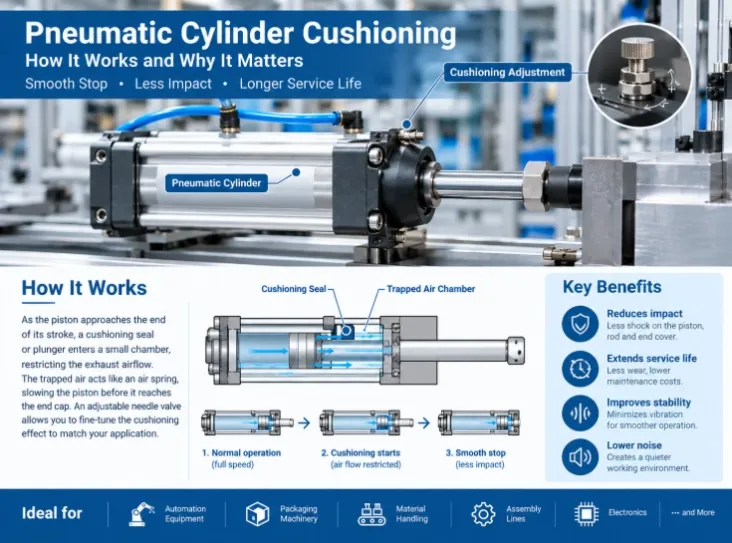
5. Cushioning Components
Many cylinders feature adjustable pneumatic cushioning at both ends of the stroke.
Cushioning slows the piston before it reaches the end cap, minimizing impact and protecting both the cylinder and connected equipment.
For high-speed automation or heavy loads, proper cushioning significantly reduces maintenance costs and improves operational stability.
6. Air Preparation Units (FRL)
Clean compressed air is essential for reliable cylinder performance.
An FRL unit combines three important functions:
- Filter – Removes dust, water, and contaminants.
- Regulator – Maintains stable working pressure.
- Lubricator – Supplies a controlled amount of oil when lubrication is required.
Providing clean and stable air helps reduce seal wear, improve efficiency, and extend cylinder life.
7. Pneumatic Fittings and Tubing
Even the highest-quality cylinder cannot perform properly if the air connections leak.
High-quality push-in fittings and PU tubing provide secure, leak-free connections while simplifying installation and maintenance. Selecting the correct tube size and thread type (PT, NPT, or G) ensures optimal airflow and system efficiency.
Using durable fittings also reduces downtime caused by air leaks and repeated replacements.
Choosing the Right Accessories
When selecting cylinder accessories, consider the following:
- Machine structure and available installation space
- Load direction and movement
- Required operating speed
- Working pressure
- Environmental conditions such as dust, moisture, or high temperatures
- Maintenance frequency and replacement costs
Choosing compatible accessories from a reliable supplier can simplify installation and improve long-term system reliability.
Conclusion
Pneumatic cylinder accessories are more than optional add-ons—they are essential components that ensure smooth operation, accurate positioning, and long service life. From mounting brackets and rod end joints to magnetic sensors, flow controls, FRL units, and pneumatic fittings, each accessory contributes to the overall performance of the pneumatic system.
By selecting the right accessories during the design stage, manufacturers can reduce equipment downtime, improve production efficiency, and lower maintenance costs over the lifetime of the machine.