Oct 9, 2026pneumatic fittings
Pneumatic Fittings Tube Size Guide: How to Choose the Right Tubing for Your Pneumatic System
Choosing the correct pneumatic tube size is essential for achieving stable airflow and efficient machine operation.
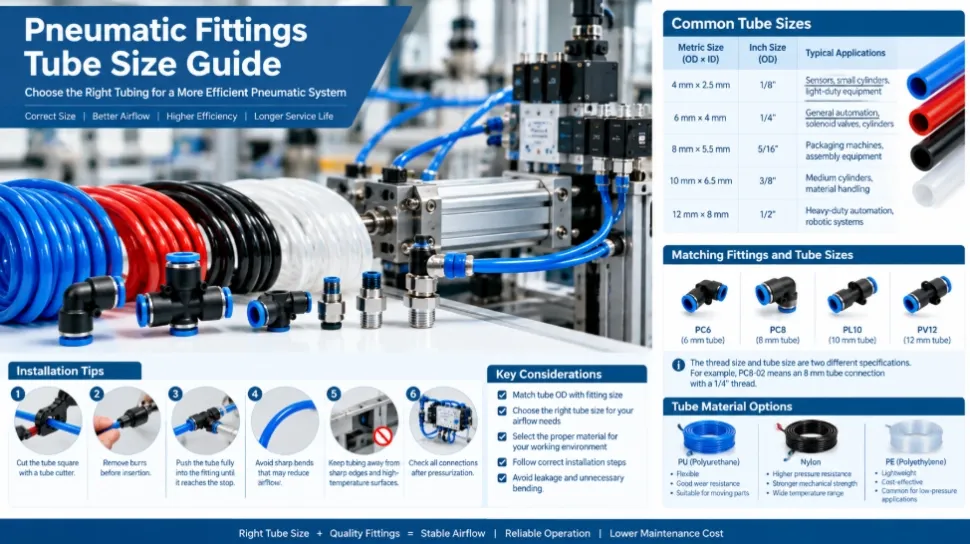
Pneumatic Fittings Tube Size Guide: How to Choose the Right Tubing for Your Pneumatic System
Selecting the correct tube size is just as important as choosing the right pneumatic fitting. Even if the fitting is well made, using the wrong tubing can cause air leakage, pressure loss, slow cylinder movement, or even unexpected machine downtime. Whether you are building a new automation system or replacing existing components, understanding tube sizes will help improve system performance and reliability.
This guide explains how pneumatic tube sizes are measured and how to choose the best option for your application.
Understanding Pneumatic Tube Size
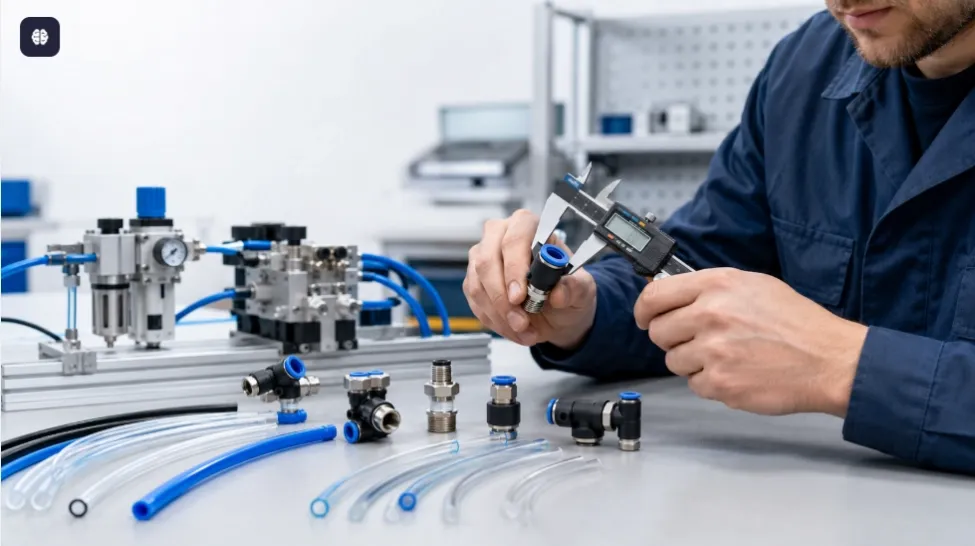
Pneumatic tubing is typically identified by its outside diameter (OD) and inside diameter (ID). Most push-to-connect fittings are designed to grip the tube by its outside diameter, so selecting the correct OD is essential.
For example:
- 4 mm OD × 2.5 mm ID
- 6 mm OD × 4 mm ID
- 8 mm OD × 5.5 mm ID
- 10 mm OD × 6.5 mm ID
- 12 mm OD × 8 mm ID
In North America, tubing is often measured in inches, such as:
- 1/8"
- 1/4"
- 5/16"
- 3/8"
- 1/2"
Always make sure the tube size matches the fitting specification.
Common Tube Sizes and Their Applications
Different tube sizes are suitable for different airflow requirements.
4 mm tubing is commonly used for compact cylinders, pneumatic sensors, and light-duty automation equipment where airflow demand is low.
6 mm tubing is one of the most popular sizes in industrial automation. It is widely used for standard pneumatic cylinders, solenoid valves, and general machine control systems.
8 mm tubing provides higher airflow and is often selected for medium-sized cylinders, packaging machinery, and assembly equipment.
10 mm and 12 mm tubing are typically used in applications requiring large air volume, including material handling equipment, robotic systems, and heavy-duty automation.
Choosing a larger tube than necessary increases installation costs, while choosing a tube that is too small restricts airflow and reduces system efficiency.
Tube Size and Airflow
Tube size directly affects airflow.
If the tubing is too small, compressed air cannot reach the actuator quickly enough. As a result, cylinders may move slowly, lose output force, or operate inconsistently.
On the other hand, oversized tubing rarely improves machine performance unless the application actually requires higher airflow.
A properly sized tube balances airflow, response speed, and installation cost.
Matching Tubing with Pneumatic Fittings
Push-in fittings are manufactured for specific tube sizes. Never force a tube into a fitting that is designed for another diameter.
For example:
- PC6 fitting → 6 mm tube
- PC8 fitting → 8 mm tube
- PL10 fitting → 10 mm tube
- PV12 fitting → 12 mm tube
The thread size and the tube size are two different specifications. A fitting marked PC8-02 usually means an 8 mm tube connection with a 1/4" thread.
Always verify both specifications before ordering.
Choosing the Right Tube Material
Tube size is only part of the selection process. Material also plays an important role.
PU (Polyurethane) tubing is flexible and suitable for applications with frequent movement.
Nylon tubing offers higher pressure resistance and better mechanical strength.
PE tubing is lightweight and commonly used for low-pressure pneumatic systems.
Select the material according to operating pressure, temperature, and the working environment.
Installation Tips
Proper installation helps maximize tube life and prevent leakage.
- Cut the tube square using a dedicated tube cutter.
- Remove burrs before inserting the tube into the fitting.
- Push the tube fully into the fitting until it reaches the internal stop.
- Avoid excessive bending that may reduce airflow.
- Keep tubing away from sharp edges and high-temperature surfaces.
- Check all connections after system pressurization.
Correct installation reduces maintenance and improves system reliability.
Conclusion
Choosing the correct pneumatic tube size is essential for achieving stable airflow and efficient machine operation. Always match the tube outside diameter with the fitting specification, select a size that meets the airflow requirements of your equipment, and use tubing material suitable for the working conditions. Careful selection of both tubing and fittings will improve system performance, reduce air leakage, and extend the service life of your pneumatic equipment.