Aug 26, 2026Air filter regulator
Pneumatic Air Preparation: Why Clean and Stable Compressed Air Matters
Pneumatic air preparation is a small part of a complete automation system, but it has a significant influence on overall reliability.
Pneumatic Air Preparation: Why Clean and Stable Compressed Air Matters
A reliable pneumatic system does not depend only on high-quality cylinders, solenoid valves, and fittings. Compressed air quality is equally important. Before compressed air reaches pneumatic equipment, it should be properly filtered and regulated—and lubricated when the application requires it.
This process is known as pneumatic air preparation.
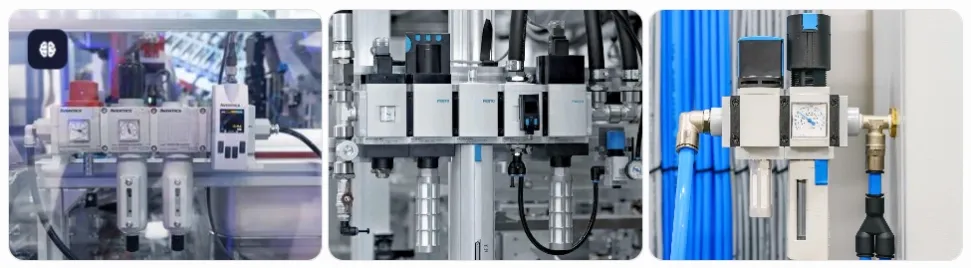
What Is Pneumatic Air Preparation?
Compressed air can contain moisture, dust, oil particles, rust, and other contaminants. Pressure can also fluctuate as air demand changes. If untreated air reaches valves, cylinders, and other pneumatic components, it can contribute to unstable operation, contamination, corrosion, or premature component wear.
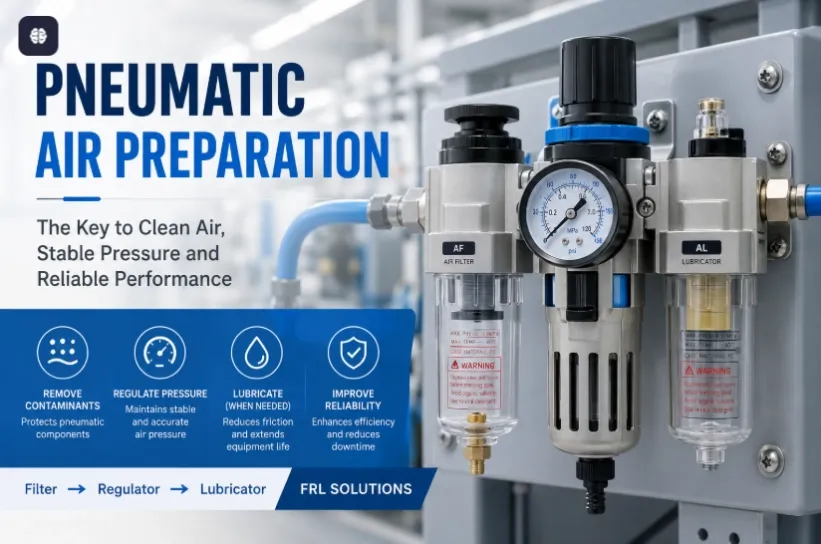
A typical pneumatic air preparation system therefore uses three basic components:
Filter → Regulator → Lubricator (when required)
Together, these components are commonly known as an FRL unit.
1. Pneumatic Air Filter
The air filter is normally the first stage of an FRL system. Its job is to help remove solid contaminants and separate condensate from compressed air before it reaches downstream equipment.
Power & Motion
For industrial pneumatic systems, common filtration options include 40 μm for general filtration and 5 μm where finer filtration is required.
Regular inspection of the filter bowl is also important. Accumulated condensate should be drained, and the filter element should be inspected according to actual operating conditions.
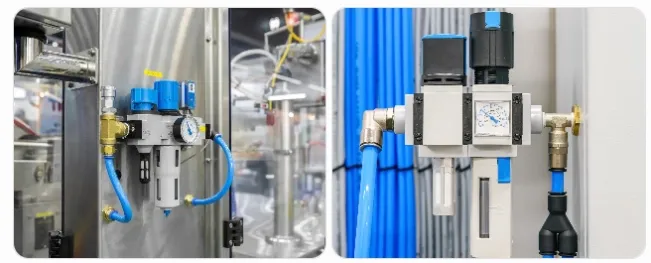
2. Pneumatic Air Regulator
After filtration, compressed air usually passes through a pressure regulator.
The regulator reduces incoming air pressure and maintains the downstream pressure required by pneumatic equipment. Stable pressure is important because cylinders, valves, actuators, and other components are designed to operate within specified pressure ranges.
Using unnecessarily high pressure can also increase compressed-air consumption, while insufficient pressure may cause cylinders or actuators to operate incorrectly.
A pressure gauge allows operators to monitor the regulated outlet pressure and make adjustments according to machine requirements.
3. Pneumatic Lubricator
The lubricator is normally installed downstream of the filter and regulator when lubricated air is required. It introduces a controlled amount of oil mist into the compressed-air stream.
However, lubricators are not required in every modern pneumatic system. Many pneumatic components are designed for non-lubricated operation, so lubrication should only be added when specified by the equipment manufacturer.
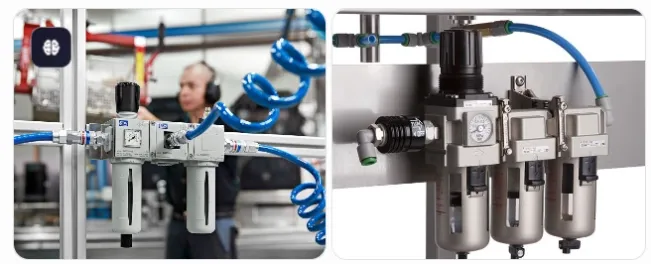
How to Select the Right Air Preparation Unit
When choosing pneumatic air preparation components, engineers should consider port size, required airflow, operating pressure, filtration precision, drain type, environmental conditions, and whether downstream equipment requires lubrication.
For many machines, a filter and regulator are sufficient. Other applications may require a complete Filter-Regulator-Lubricator combination. Compact filter-regulator combinations are also useful when installation space is limited.
Correct sizing is important because an undersized air preparation unit can restrict airflow and create excessive pressure drop.
Better Air Preparation, More Reliable Pneumatic Systems
Pneumatic air preparation is a small part of a complete automation system, but it has a significant influence on overall reliability.
A properly selected air filter, pressure regulator, lubricator, filter-regulator, or complete FRL units provide cleaner air and controlled pressure to downstream pneumatic equipment. Regular checks of condensate, pressure settings, airflow direction, leakage, and filter condition are equally important.
For machine builders, automation companies, and pneumatic distributors, selecting the right air preparation components should therefore be considered an essential part of pneumatic system design—not simply an accessory.