Oct 20, 2026pneumatic fittings
Why Thread Thickness Matters in Pneumatic Fittings
A thicker thread improves installation strength, reduces the risk of leakage, withstands vibration, and extends product life.
Why Thread Thickness Matters in Pneumatic Fittings
In a pneumatic system, attention is often focused on air pressure, tubing size, or cylinder selection. However, one detail that is frequently overlooked is the thickness of the threaded connection on a pneumatic fitting. While it may seem like a small design feature, thread thickness has a direct impact on sealing performance, mechanical strength, installation reliability, and service life.
For industrial applications where equipment operates continuously, a stronger threaded connection can make the difference between a stable system and repeated maintenance.
What Is Thread Thickness?
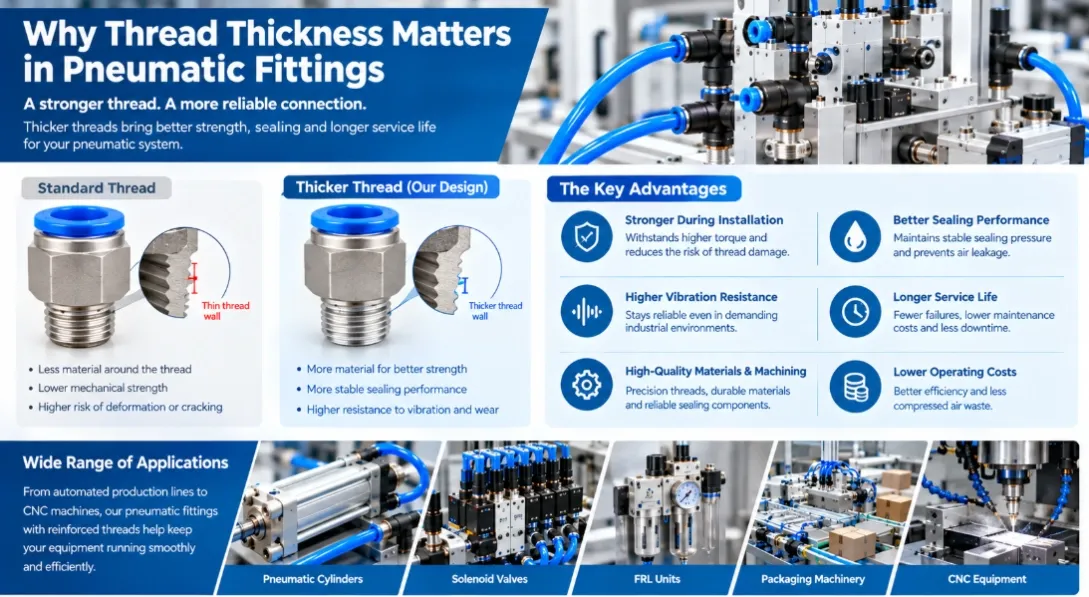
Thread thickness refers to the amount of material surrounding the threaded section of a pneumatic fitting. On many low-cost fittings, manufacturers reduce material around the thread to save production costs. Although these fittings may appear similar from the outside, they often have weaker structural strength.
A thicker threaded section provides more material to support the connection, making the fitting more resistant to stress during installation and long-term operation.
Better Strength During Installation
One of the most common causes of fitting damage occurs during assembly.
When technicians tighten a fitting into a valve, cylinder, or manifold, the threaded area experiences significant torque. If the thread wall is too thin, it can deform or even crack, especially if the fitting is over-tightened.
A thicker threaded section distributes installation force more evenly and greatly reduces the risk of:
- Thread deformation
- Cracked fitting bodies
- Damaged sealing surfaces
- Thread stripping
This is particularly important in automated production where hundreds or even thousands of fittings are installed every day.
Improved Sealing Performance
A reliable pneumatic system depends on leak-free connections.
When the threaded section is stronger and more rigid, the sealing surface remains stable after installation. The fitting is less likely to distort under pressure, allowing PTFE tape or thread sealant to perform more effectively.
Stable threads help maintain:
- Consistent sealing pressure
- Reduced air leakage
- Stable operating pressure
- Lower compressed air consumption
Even a small air leak can increase compressor running time and raise energy costs over the life of the equipment.
Greater Resistance to Vibration
Many industrial machines operate under constant vibration.
Packaging equipment, CNC machines, textile machinery, and automated assembly lines all generate continuous movement that places stress on threaded connections.
Thin-thread fittings may gradually loosen or develop tiny cracks after long periods of vibration.
A thicker threaded design provides better mechanical support and improves long-term stability in demanding applications.
Longer Service Life
Replacing a damaged fitting may seem inexpensive, but the downtime caused by a leaking pneumatic system can be costly.
Fittings with reinforced threaded sections generally offer:
- Better fatigue resistance
- Higher durability
- Reduced maintenance frequency
- Longer operating life
For OEM manufacturers and maintenance teams, fewer unexpected failures mean lower maintenance costs and improved production efficiency.
Why Material and Thread Design Work Together
Thread thickness alone is not enough. A high-quality pneumatic fitting also depends on good materials and precise machining.
For example, many premium push-in fittings combine:
- Engineering plastic bodies with high impact resistance
- Nickel-plated brass threaded inserts for corrosion protection
- Precision-machined threads for smooth installation
- High-quality sealing rings for reliable air-tight performance
When these features are combined with a thicker threaded section, the fitting becomes much more dependable in demanding industrial environments.
Choosing the Right Pneumatic Fitting
When comparing pneumatic fittings, don't evaluate them by appearance alone.
Ask suppliers about:
- Thread wall thickness
- Thread machining accuracy
- Pressure rating
- Material quality
- Corrosion resistance
- Sealing performance
- Quality inspection standards
A fitting that costs slightly more often delivers much greater value through improved reliability and reduced maintenance.
Conclusion
The threaded section of a pneumatic fitting may be small, but it plays a major role in system reliability. A thicker thread improves installation strength, reduces the risk of leakage, withstands vibration, and extends product life. For manufacturers, machine builders, and maintenance professionals, choosing fittings with reinforced threaded connections is a practical investment that helps ensure stable, efficient, and trouble-free pneumatic operation.