Oct 21, 2026pneumatic fittings
What Makes a Pneumatic Fitting Durable?
Choosing durable fittings helps reduce air leaks, minimize maintenance, improve system efficiency, and keep industrial equipment running reliably for years
What Makes a Pneumatic Fitting Durable?
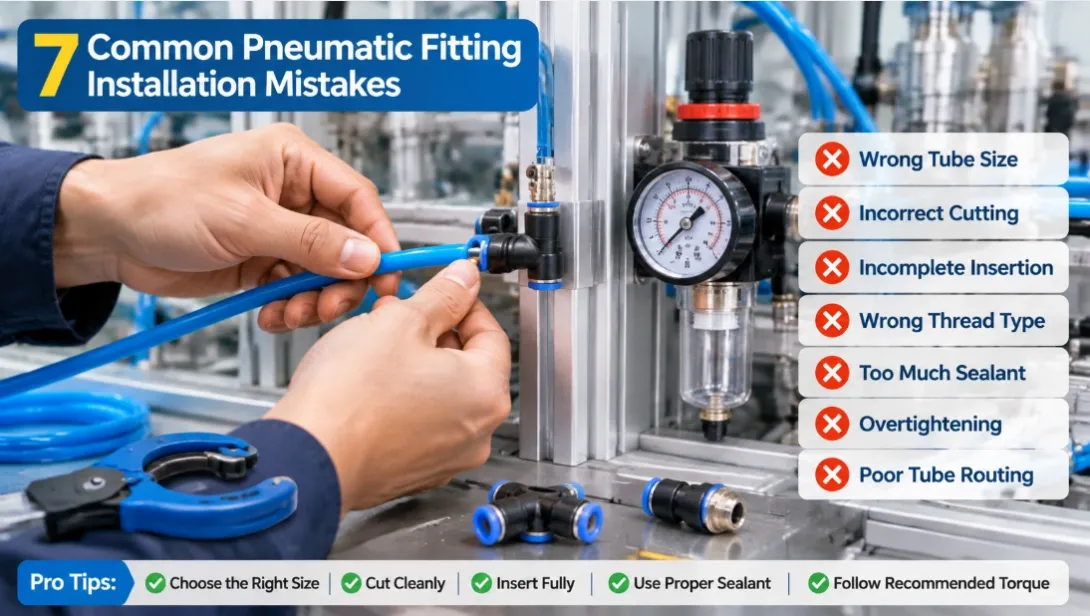
Pneumatic fittings may be small components, but they play a critical role in every compressed air system. A single fitting failure can lead to air leaks, pressure loss, machine downtime, and increased maintenance costs. That's why durability is one of the most important factors when selecting pneumatic fittings for industrial applications.
However, not all fittings are built to the same standard. While many products look similar from the outside, differences in materials, design, machining, and manufacturing quality can have a significant impact on long-term performance.
Material Quality Is the Foundation
The durability of a pneumatic fitting starts with the materials used.
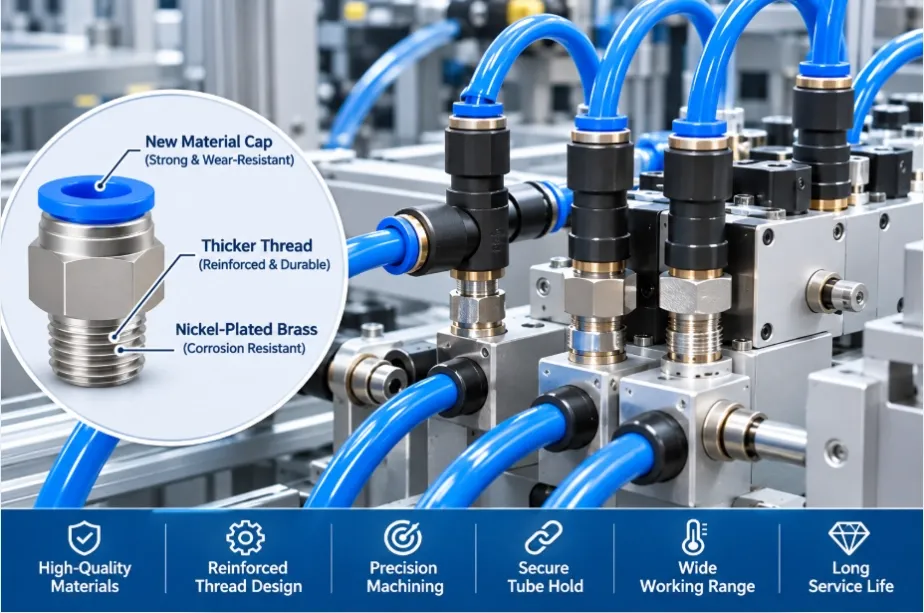
For push-in fittings, the threaded section is commonly made from brass with a nickel-plated finish. High-quality brass offers excellent mechanical strength, while nickel plating improves corrosion resistance and provides a cleaner appearance. The plastic body should be made from engineering-grade materials that can withstand repeated use, vibration, and moderate impacts without cracking.
Sealing components are equally important. High-quality O-rings made from materials such as NBR maintain their elasticity over time, helping to prevent air leaks even after thousands of operating cycles.
Stronger Thread Design Improves Reliability
The threaded connection experiences the highest mechanical stress during installation.
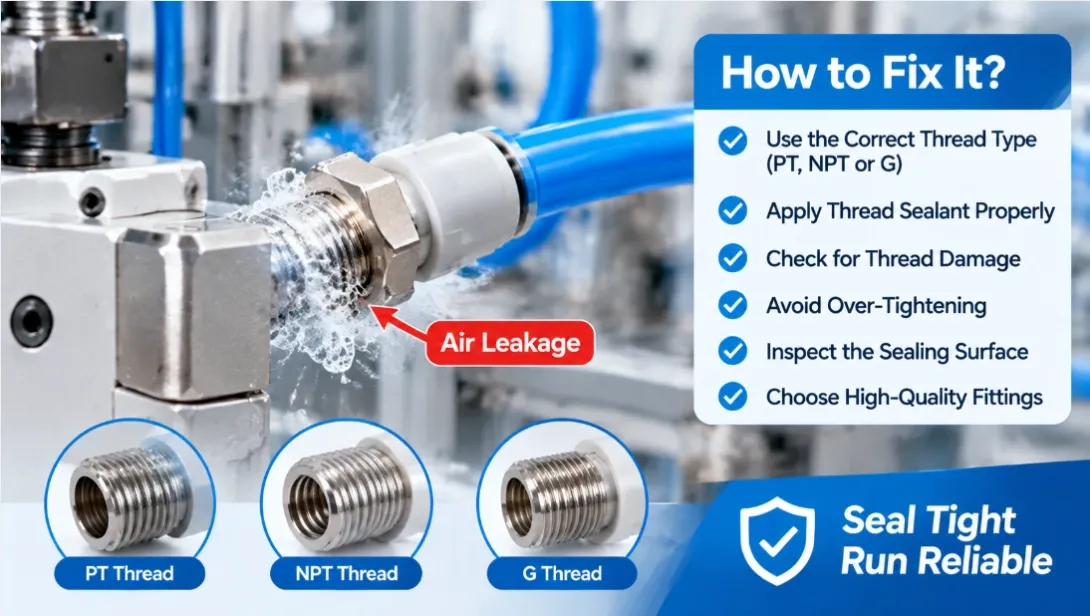
Some low-cost fittings reduce the thickness of the threaded section to save material. While this lowers manufacturing costs, it also increases the risk of thread deformation, cracking, or stripping when tightened.
A reinforced threaded design provides greater mechanical strength and better distributes installation force. It also creates a more stable sealing surface, reducing the possibility of air leakage during long-term operation.
For industrial users, a thicker threaded section often translates into a longer service life and fewer maintenance issues.
Precision Machining Matters
Even premium materials cannot compensate for poor machining.
A durable pneumatic fitting requires accurately machined threads that engage smoothly with valves, cylinders, and manifolds. Precision machining helps prevent cross-threading during installation and ensures consistent sealing performance.
The internal air passage should also be clean and well-finished. Smooth internal surfaces reduce airflow resistance and minimize pressure loss, improving overall system efficiency.
Secure Tube Holding Performance
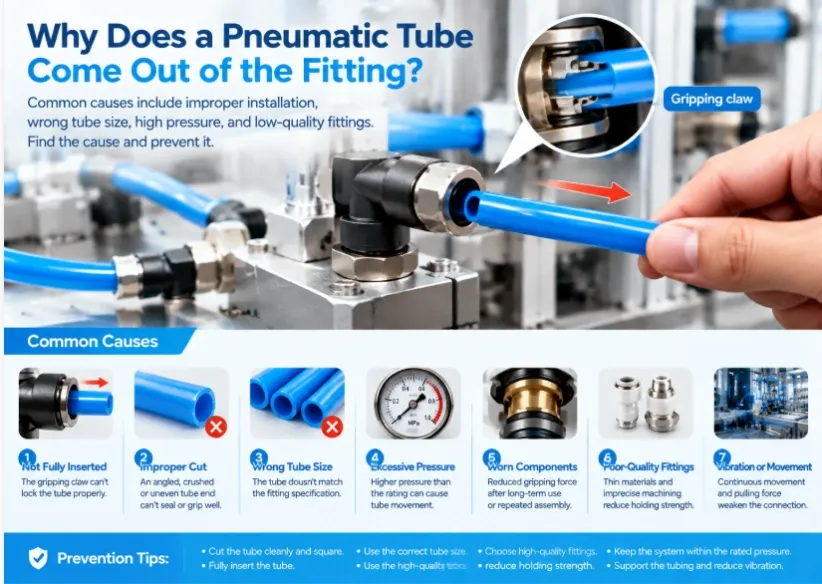
One of the most important features of a push-in fitting is its ability to hold the tube securely.
Inside the fitting, the stainless steel gripping mechanism must provide strong retention without damaging the tube. At the same time, the release collar should allow the tube to be disconnected easily during maintenance.
High-quality gripping components maintain their holding force even after repeated insertion and removal, ensuring reliable performance throughout the product's service life.
Resistance to Harsh Working Conditions
Industrial pneumatic systems often operate in challenging environments.
Fittings may be exposed to:
- Continuous machine vibration
- Dust and airborne particles
- Moisture and humidity
- Temperature fluctuations
- Frequent pressure changes
Durable pneumatic fittings are designed to maintain sealing performance under these conditions without loosening or cracking. Corrosion-resistant materials and quality surface treatments further improve their reliability in demanding environments.
Consistent Manufacturing Quality
Durability depends not only on design but also on manufacturing consistency.
Reliable manufacturers implement strict quality control throughout production, including raw material inspection, dimensional measurement, pressure testing, leak testing, and appearance inspection.
Consistent production ensures that every fitting delivers the same level of performance, reducing unexpected failures in large-scale industrial installations.
Choosing a Durable Pneumatic Fitting
When evaluating pneumatic fittings, don't focus only on price. Consider the overall value by asking the following questions:
- Is the threaded section reinforced?
- Are high-quality materials used?
- Does the fitting have precision-machined threads?
- Are the sealing components reliable?
- Has the product been pressure tested?
- Can the fitting withstand long-term industrial use?
A slightly higher initial cost often results in lower maintenance expenses, reduced downtime, and improved system reliability over time.
Our Quality Advantage
Our pneumatic fittings are designed for industrial applications where reliability is essential. The threaded interface is reinforced with a thicker design for improved mechanical strength, while the cap is manufactured using new engineering-grade material for enhanced durability. The threaded section features nickel-plated brass for corrosion resistance, and precision machining ensures smooth installation and dependable sealing performance.
Combined with strict quality inspection and stable manufacturing processes, these features help deliver longer service life and consistent performance across a wide range of automation equipment.
Conclusion
A durable pneumatic fitting is more than just a connector. It is the result of quality materials, reinforced structural design, precision machining, reliable sealing, and consistent manufacturing. Choosing durable fittings helps reduce air leaks, minimize maintenance, improve system efficiency, and keep industrial equipment running reliably for years. For OEM manufacturers, distributors, and maintenance professionals, investing in high-quality pneumatic fittings is an investment in the long-term performance of the entire pneumatic system.