Oct 26, 2026pneumatic fittings
Virgin Plastic vs Recycled Plastic in Pneumatic Fittings
Virgin plastic provides greater strength, durability, and sealing reliability than recycled plastic, reducing maintenance while extending pneumatic fitting service life.
Virgin Plastic vs Recycled Plastic in Pneumatic Fittings
When comparing pneumatic fittings, most buyers focus on thread size, pressure rating, or price. However, one important factor is often overlooked—the quality of the plastic used to manufacture the release ring and fitting body.
At first glance, fittings made from virgin plastic and recycled plastic may appear almost identical. After several months of operation, however, the difference becomes obvious. Material quality directly affects sealing performance, service life, and overall reliability.
What Is Virgin Plastic?
Virgin plastic is produced from new raw materials that have never been used before. Because it has not gone through previous processing cycles, its molecular structure remains stable and consistent.
For pneumatic fittings, manufacturers commonly use engineering-grade plastics that provide high strength, excellent dimensional accuracy, and good resistance to wear and impact. The material also maintains its mechanical properties over a wide temperature range.
These characteristics help ensure that the fitting performs consistently throughout its service life.
What Is Recycled Plastic?
Recycled plastic is made from plastic waste that has been collected, melted, and processed into new products. While recycling is beneficial in many industries, the quality of recycled material can vary significantly depending on its source and processing method.
Repeated heating during recycling gradually weakens the polymer structure. As a result, recycled plastic may become more brittle and less resistant to stress, especially in demanding industrial environments.
For pneumatic components that require precise dimensions and repeated operation, inconsistent material properties can become a long-term concern.
Performance Comparison
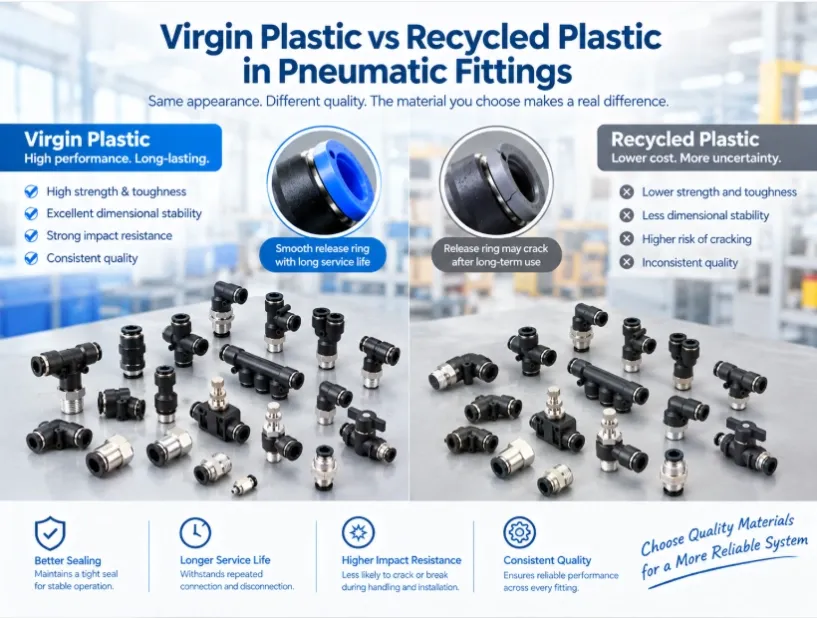
The release ring is one of the most frequently used parts of a push-in fitting. Every time the tube is connected or removed, the release ring experiences mechanical stress.
A release ring made from virgin plastic maintains its shape after thousands of operating cycles. It continues to move smoothly without cracking or excessive wear.
By comparison, recycled plastic may become brittle after prolonged use. Small cracks can develop around the release ring, making tube removal difficult and increasing the possibility of fitting failure.
Impact resistance is another important difference. During transportation, installation, or routine maintenance, fittings are occasionally dropped or knocked against equipment. Virgin plastic absorbs these impacts more effectively, while recycled materials are generally more susceptible to cracking.
Why Material Consistency Matters
Industrial automation depends on repeatable performance. A pneumatic fitting may be installed in packaging equipment, CNC machinery, food processing lines, textile machines, or robotic automation where downtime is costly.
Consistent material quality helps ensure that every fitting performs the same way, reducing maintenance requirements and improving production reliability.
Dimensional consistency is equally important. Virgin plastic allows manufacturers to maintain tighter production tolerances, resulting in better sealing between the tube, release ring, and internal components.
Looking Beyond the Purchase Price
Recycled plastic fittings are often less expensive, making them attractive for projects with tight budgets. However, the initial savings can quickly disappear if fittings require frequent replacement or cause unexpected air leaks.
A fitting manufactured from virgin plastic typically offers a longer service life, fewer maintenance issues, and more stable performance under continuous operation. For equipment manufacturers and industrial distributors, these advantages often reduce the total cost of ownership over time.
Choosing the Right Supplier
Material quality is only one part of a reliable pneumatic fitting. Buyers should also evaluate thread machining, sealing components, gripping claws, nickel-plated brass inserts, and the manufacturer's quality control process.
Some manufacturers further improve durability by using thicker threaded sections, precision-machined brass inserts, and high-quality virgin plastic for the release ring and cap. These design details help maintain stable performance even in demanding industrial applications.
Conclusion
Virgin plastic and recycled plastic may look similar, but their long-term performance is very different. Virgin plastic offers better strength, higher impact resistance, greater dimensional stability, and a longer service life.
When selecting pneumatic fittings, buyers should consider more than the purchase price. Choosing fittings made from high-quality virgin plastic can improve system reliability, reduce maintenance costs, and deliver better value throughout the life of the equipment.