
Oct 24, 2026pneumatic fittings

Five Quality Details Buyers Should Check Before Purchasing Pneumatic Fittings

Inspect thread thickness, release ring, gripping claw, sealing ring, and body material to choose reliable pneumatic fittings with lasting performance.
c2d7f52c-900c-4955-a479-8eaeeb155b36
Five Quality Details Buyers Should Check Before Purchasing Pneumatic Fittings
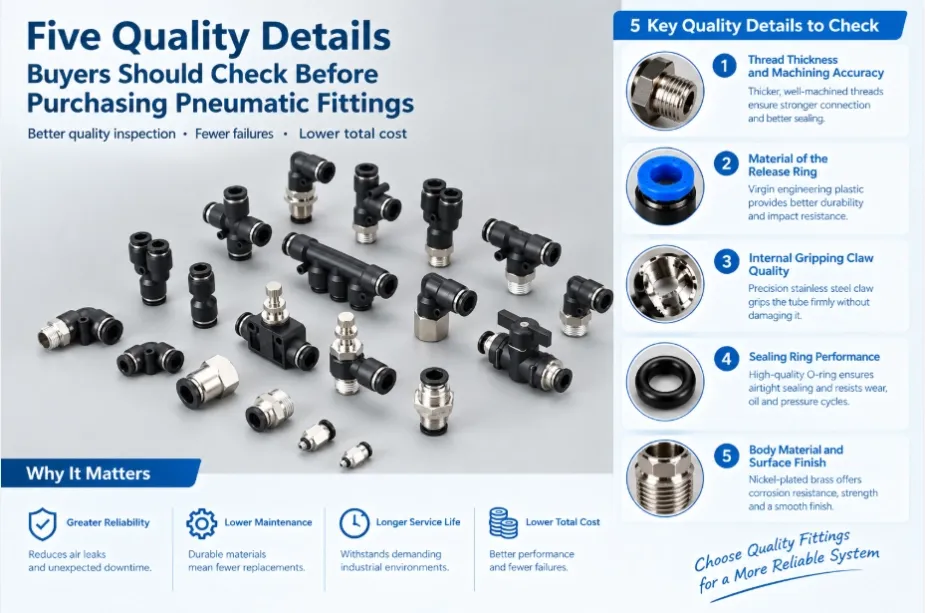
Choosing pneumatic fittings based on price alone can lead to air leaks, unexpected downtime, and higher maintenance costs. At first glance, most push-in fittings look almost identical, but their internal materials and manufacturing quality can vary significantly. For distributors, equipment manufacturers, and maintenance engineers, knowing what to inspect before placing an order can help avoid expensive problems later.
Here are five important quality details every buyer should check before purchasing pneumatic fittings.

1. Thread Thickness and Machining Accuracy

The threaded section is one of the most important parts of a pneumatic fitting. Thin or poorly machined threads are more likely to crack during installation or fail to seal properly.
A well-made fitting has clean, accurately machined threads with a thicker thread base for improved strength. The fitting should screw smoothly into the port without excessive force or looseness.
If your application involves frequent assembly or vibration, stronger threads can significantly improve long-term reliability.

2. Material of the Release Ring

The release ring may look like a simple plastic component, but it directly affects how easily the tube can be installed and removed.
Many low-cost fittings use recycled plastic, which becomes brittle over time and may crack after repeated use. High-quality fittings use virgin engineering plastic with better impact resistance and dimensional stability.
A durable release ring continues to operate smoothly even after thousands of connection cycles, reducing maintenance and replacement costs.

3. Internal Gripping Claw Quality

Inside every push-in fitting is a stainless steel gripping claw that locks the tube in position.
The claw should grip the tube firmly without damaging its outer surface. Precision-machined stainless steel claws provide consistent holding force while allowing easy tube removal when the release ring is pressed.
Inferior claws often lose their gripping strength over time or scratch the tubing, eventually causing leakage or tube pull-out.

4. Sealing Ring Performance

The O-ring is responsible for creating the airtight seal between the fitting and the tube.
A quality sealing ring should be made from reliable materials such as NBR and manufactured with consistent dimensions. It should resist wear, compressed air, lubricating oil, and repeated pressure cycles.
Poor-quality seals may work initially but often become hard, deformed, or cracked after extended use, resulting in air leakage and increased energy consumption.

5. Body Material and Surface Finish

The fitting body determines the overall durability of the product. Nickel-plated brass remains one of the most popular choices because it combines corrosion resistance with excellent mechanical strength.
Inspect the surface finish carefully. High-quality fittings have a smooth, uniform nickel plating without scratches, burrs, or rough edges. Precision machining also ensures accurate dimensions and easier installation.
For demanding industrial environments, a well-finished fitting offers better corrosion resistance and a longer service life.

Why Small Details Matter

Each fitting is only a small part of a pneumatic system, but hundreds of fittings may be installed on a single production line. Even a small failure rate can lead to frequent maintenance, compressed air loss, and unexpected machine stoppages.
Many experienced buyers no longer compare fittings by appearance alone. Instead, they evaluate the internal structure, material quality, machining accuracy, and manufacturing consistency before making purchasing decisions.

Final Thoughts

Reliable pneumatic fittings are built from quality materials and manufactured with attention to detail. Before selecting a supplier, ask about thread design, plastic materials, sealing components, gripping claws, and quality inspection procedures.
A fitting with stronger threads, virgin plastic components, premium seals, and precision machining may cost slightly more, but it delivers greater reliability, fewer maintenance issues, and a lower total operating cost throughout the life of your pneumatic system.
Read next

Oct 24, 2026pneumatic fittings

Five Quality Details Buyers Should Check Before Purchasing Pneumatic Fittings

Inspect thread thickness, release ring, gripping claw, sealing ring, and body material to choose reliable pneumatic fittings with lasting performance.

c2d7f52c-900c-4955-a479-8eaeeb155b36
Five Quality Details Buyers Should Check Before Purchasing Pneumatic Fittings
Choosing pneumatic fittings based on price alone can lead to air leaks, unexpected downtime, and higher maintenance costs. At first glance, most push-in fittings look almost identical, but their internal materials and manufacturing quality can vary significantly. For distributors, equipment manufacturers, and maintenance engineers, knowing what to inspect before placing an order can help avoid expensive problems later.
Here are five important quality details every buyer should check before purchasing pneumatic fittings.

1. Thread Thickness and Machining Accuracy

The threaded section is one of the most important parts of a pneumatic fitting. Thin or poorly machined threads are more likely to crack during installation or fail to seal properly.
A well-made fitting has clean, accurately machined threads with a thicker thread base for improved strength. The fitting should screw smoothly into the port without excessive force or looseness.
If your application involves frequent assembly or vibration, stronger threads can significantly improve long-term reliability.

2. Material of the Release Ring

The release ring may look like a simple plastic component, but it directly affects how easily the tube can be installed and removed.
Many low-cost fittings use recycled plastic, which becomes brittle over time and may crack after repeated use. High-quality fittings use virgin engineering plastic with better impact resistance and dimensional stability.
A durable release ring continues to operate smoothly even after thousands of connection cycles, reducing maintenance and replacement costs.

3. Internal Gripping Claw Quality

Inside every push-in fitting is a stainless steel gripping claw that locks the tube in position.
The claw should grip the tube firmly without damaging its outer surface. Precision-machined stainless steel claws provide consistent holding force while allowing easy tube removal when the release ring is pressed.
Inferior claws often lose their gripping strength over time or scratch the tubing, eventually causing leakage or tube pull-out.

4. Sealing Ring Performance

The O-ring is responsible for creating the airtight seal between the fitting and the tube.
A quality sealing ring should be made from reliable materials such as NBR and manufactured with consistent dimensions. It should resist wear, compressed air, lubricating oil, and repeated pressure cycles.
Poor-quality seals may work initially but often become hard, deformed, or cracked after extended use, resulting in air leakage and increased energy consumption.

5. Body Material and Surface Finish

The fitting body determines the overall durability of the product. Nickel-plated brass remains one of the most popular choices because it combines corrosion resistance with excellent mechanical strength.
Inspect the surface finish carefully. High-quality fittings have a smooth, uniform nickel plating without scratches, burrs, or rough edges. Precision machining also ensures accurate dimensions and easier installation.
For demanding industrial environments, a well-finished fitting offers better corrosion resistance and a longer service life.

Why Small Details Matter

Each fitting is only a small part of a pneumatic system, but hundreds of fittings may be installed on a single production line. Even a small failure rate can lead to frequent maintenance, compressed air loss, and unexpected machine stoppages.
Many experienced buyers no longer compare fittings by appearance alone. Instead, they evaluate the internal structure, material quality, machining accuracy, and manufacturing consistency before making purchasing decisions.

Final Thoughts

Reliable pneumatic fittings are built from quality materials and manufactured with attention to detail. Before selecting a supplier, ask about thread design, plastic materials, sealing components, gripping claws, and quality inspection procedures.
A fitting with stronger threads, virgin plastic components, premium seals, and precision machining may cost slightly more, but it delivers greater reliability, fewer maintenance issues, and a lower total operating cost throughout the life of your pneumatic system.


Recommended articles

Guides visitors may want next

Helpful guides, field notes, and stories for choosing with more context.