Oct 19, 2026pneumatic fittings
Complete Guide to Pneumatic Fitting Types
Straight fittings, elbows, tees, Y fittings, unions, bulkhead fittings, and flow control fittings each solve different installation challenges.
Complete Guide to Pneumatic Fitting Types
Pneumatic fittings may look like small components, but they play a critical role in every compressed air system. They connect air tubes, valves, cylinders, FRL units, and other pneumatic equipment while ensuring reliable airflow and leak-free performance. Choosing the right fitting type can improve installation efficiency, reduce maintenance, and extend the life of the entire system.
This guide introduces the most common pneumatic fitting types and explains where each one is best used.
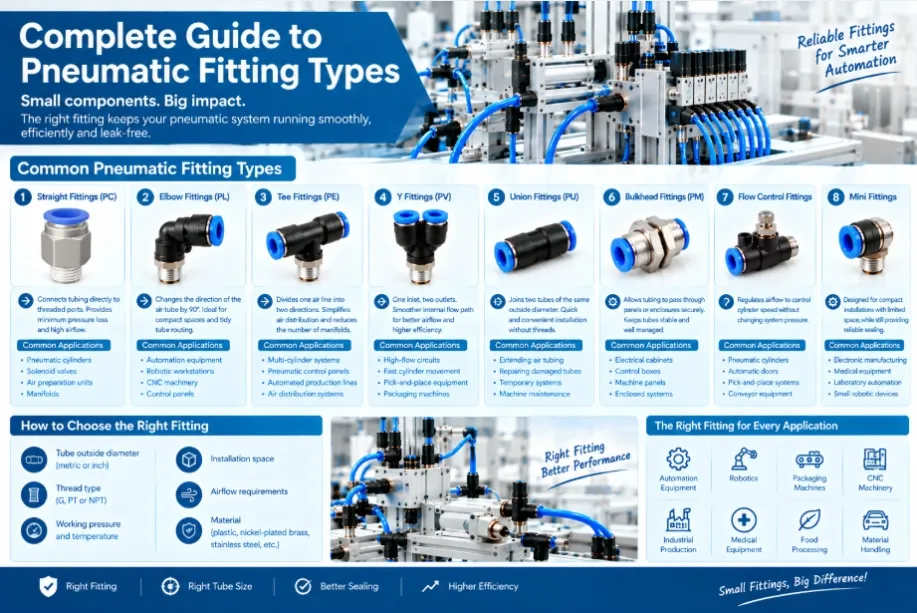
1. Straight Fittings (PC)
Straight fittings, often called PC fittings, are the most widely used push-to-connect fittings. They connect tubing directly to threaded ports and provide the shortest airflow path with minimal pressure loss.
Typical applications include:
- Pneumatic cylinders
- Solenoid valves
- Air preparation units
- Manifolds
- Packaging machinery
Straight fittings are easy to install and are an excellent choice when the tube enters the equipment in a straight line.
2. Elbow Fittings (PL)
PL fittings feature a 90-degree design that changes the direction of the air tube. They are commonly used where installation space is limited or where tubing needs to avoid nearby components.
Advantages include:
- Cleaner tube routing
- Reduced tube bending
- Easier installation in compact machines
- Better appearance of pneumatic systems
PL fittings are widely used in automation equipment, robotic workstations, and CNC machinery.
3. Tee Fittings (PE)
Tee fittings divide one air line into two separate directions. They are ideal for supplying compressed air to multiple cylinders or valves from a single source.
Common uses include:
- Multi-cylinder systems
- Pneumatic control panels
- Automated production lines
- Air distribution systems
Using tee fittings can reduce the number of manifolds required and simplify pneumatic layouts.
4. Y Fittings (PV)
PV fittings provide one inlet and two outlets with a Y-shaped design. Compared with standard tee fittings, the smoother internal flow path helps reduce airflow resistance.
PV fittings are often selected for:
- High-flow pneumatic circuits
- Fast cylinder movement
- Pick-and-place equipment
- Packaging machines
When stable airflow is important, a Y fitting is often the better option.
5. Union Fittings (PU)
Union fittings connect two pieces of pneumatic tubing with the same outside diameter. Since no threaded connection is required, installation is quick and convenient.
Typical applications include:
- Extending air tubing
- Repairing damaged tube sections
- Temporary pneumatic systems
- Machine maintenance
They are one of the simplest yet most frequently used fittings in industrial automation.
6. Bulkhead Fittings (PM)
Bulkhead fittings allow tubing to pass securely through machine panels, cabinets, or protective enclosures.
Their benefits include:
- Secure installation
- Better cable and tube management
- Protection against tube movement
- Professional equipment appearance
These fittings are common in electrical control cabinets and automation control boxes.
7. Flow Control Fittings
Flow control fittings combine a push-in fitting with an adjustable speed controller. By regulating the airflow entering or leaving a cylinder, they control cylinder speed without changing the system pressure.
Typical applications include:
- Pneumatic cylinders
- Automatic doors
- Pick-and-place systems
- Conveyor equipment
Proper speed adjustment helps reduce impact, vibration, and noise.
8. Mini Fittings
Miniature pneumatic fittings are designed for compact automation equipment where installation space is limited.
They are widely used in:
- Electronic manufacturing
- Medical equipment
- Laboratory automation
- Small robotic devices
Despite their small size, they still provide reliable sealing and fast installation.
How to Choose the Right Pneumatic Fitting
Before selecting a fitting, consider the following factors:
- Tube outside diameter (metric or inch)
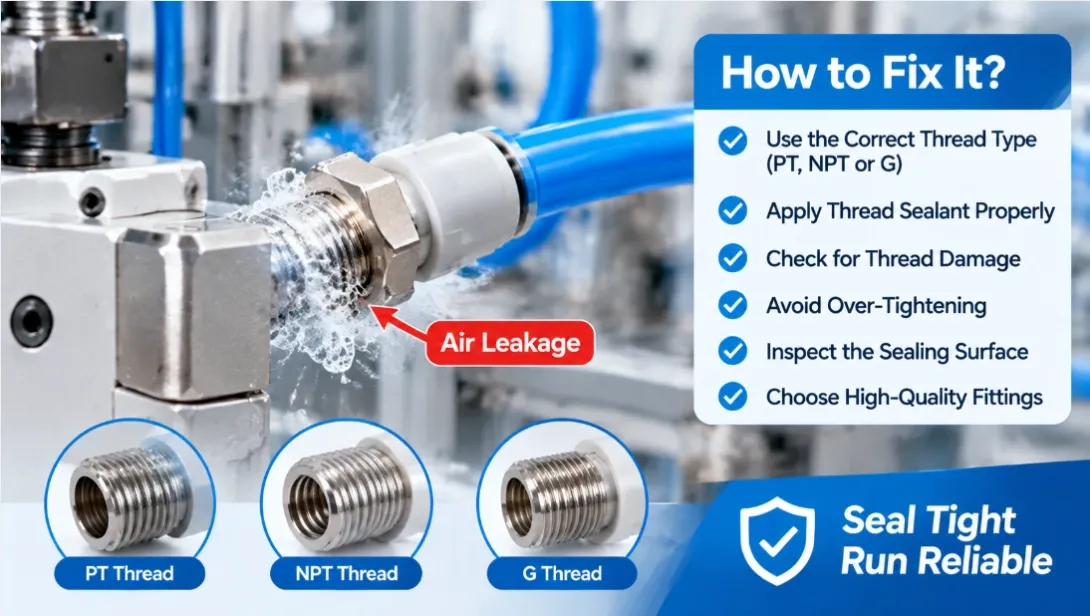
- Thread type (G, PT, or NPT)
- Working pressure and temperature
- Installation space
- Airflow requirements
- Material, such as engineering plastic, nickel-plated brass, or stainless steel
Choosing the correct fitting not only prevents air leaks but also improves system efficiency and reduces future maintenance costs.
Conclusion
There is no single pneumatic fitting that suits every application. Straight fittings, elbows, tees, Y fittings, unions, bulkhead fittings, and flow control fittings each solve different installation challenges. Understanding their functions allows engineers and maintenance teams to build pneumatic systems that are easier to install, more reliable, and more efficient.
Whether you are designing a new automation line or replacing existing components, selecting the right fitting type is a small decision that makes a big difference in overall system performance.