Oct 22, 2026pneumatic fittings
Cheap vs High-Quality Pneumatic Fittings: What Is the Real Difference?
The difference between a cheap pneumatic fitting and a high-quality one is not simply appearance or price. It comes down to material selection, manufacturing precision, sealing performance, durability
Cheap vs High-Quality Pneumatic Fittings: What Is the Real Difference?
When purchasing pneumatic fittings, many buyers focus on price first. At first glance, two fittings may look almost identical, yet one costs significantly less than the other. The question is: does the higher price really make a difference?
In industrial automation, the answer is often yes. The true cost of a pneumatic fitting is not just its purchase price—it is the total cost of reliability, maintenance, downtime, and service life.
Material Quality Makes the First Difference
One of the biggest differences between low-cost and high-quality fittings is the material.
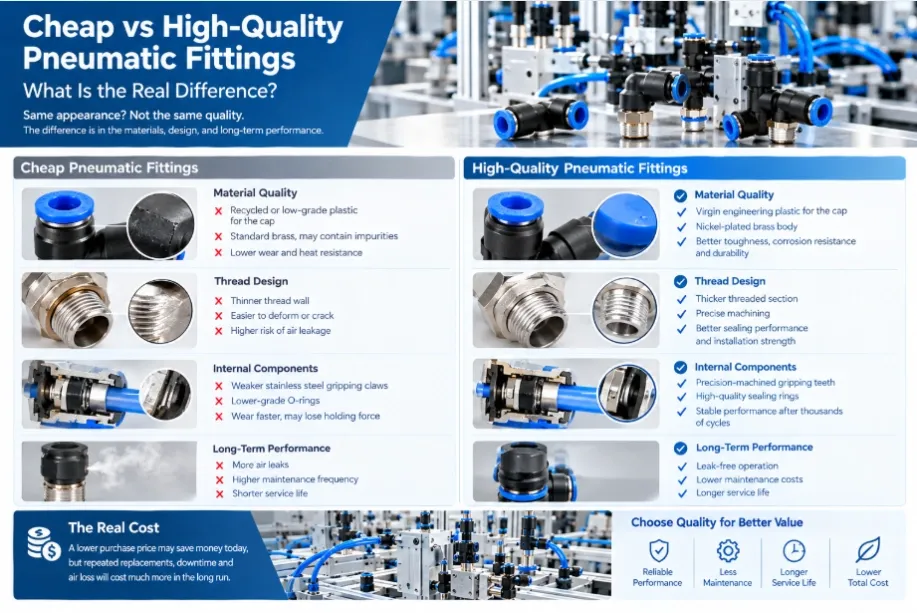
Many inexpensive fittings use recycled plastic for the release cap and low-grade brass for the threaded body. Recycled plastic becomes brittle over time, especially in high-temperature or high-cycle applications. Low-quality brass may contain more impurities, making it easier to crack during installation or long-term use.
High-quality fittings typically use new engineering-grade plastic combined with nickel-plated brass. Virgin plastic provides better toughness and wear resistance, while the nickel-plated brass body offers excellent corrosion resistance and maintains its strength after repeated assembly.
The result is a fitting that performs consistently in demanding industrial environments.
Thread Design Matters More Than You Think
Many buyers overlook the threaded portion of a fitting, but this is often where failures begin.
Budget fittings frequently have thinner threads to reduce material costs. Under repeated tightening or vibration, these threads can deform, crack, or leak.
Premium fittings generally feature a thicker threaded section with more precise machining. The additional material improves strength and provides better sealing performance, especially in applications with frequent maintenance or higher operating pressure.
A stronger thread also reduces the chance of damage during installation, making maintenance easier over the product's lifetime.
Internal Components Affect Long-Term Performance
The inside of a push-in fitting is where quality becomes obvious.
A low-quality fitting may use weaker stainless steel gripping claws, lower-grade O-rings, or poorly finished internal components. These parts wear faster and can lose their holding force after repeated tube insertion.
A high-quality fitting uses precision-machined gripping teeth, durable sealing rings, and accurately assembled internal parts. Tubes lock securely, seals remain tight, and the fitting maintains stable performance even after thousands of connection cycles.
These details are not always visible from the outside, but they make a major difference in daily operation.
Leakage Can Become an Expensive Problem
A leaking fitting may seem like a minor issue, but compressed air is expensive to produce.
Small leaks increase compressor running time, waste energy, reduce machine efficiency, and may eventually lead to production interruptions. In large factories with hundreds of pneumatic connections, even a tiny leak can create significant operating costs over time.
Choosing a reliable fitting from the beginning is often far less expensive than dealing with repeated maintenance and air loss.
Service Life Reduces Overall Cost
Some buyers compare fittings only by their purchase price.
For example, a fitting that costs 20% less may need replacement several times during the life of the equipment. Each replacement requires maintenance labor, machine downtime, and new parts.
A higher-quality fitting may operate reliably for years with minimal maintenance. Although the initial investment is slightly higher, the total ownership cost is usually much lower.
Professional equipment manufacturers often evaluate components based on lifecycle cost rather than unit price alone.
How to Identify a Quality Pneumatic Fitting
Before placing an order, consider these questions:
Is the release cap made from virgin engineering plastic?
Is the brass body nickel-plated for corrosion resistance?
Is the threaded section thicker than standard fittings?
Are the threads clean and precisely machined?
Does the tube lock firmly without slipping?
Can the supplier provide consistent quality and stable production?
If the answer to these questions is yes, the fitting is far more likely to deliver reliable long-term performance.
Final Thoughts
The difference between a cheap pneumatic fitting and a high-quality one is not simply appearance or price. It comes down to material selection, manufacturing precision, sealing performance, durability, and reliability.
For industrial automation, every pneumatic connection affects system performance. Investing in quality fittings helps reduce leakage, lower maintenance costs, improve equipment reliability, and protect production efficiency.
When selecting pneumatic fittings, the lowest purchase price is rarely the best value. A well-designed, high-quality fitting delivers better performance, longer service life, and greater confidence throughout the entire operation.